
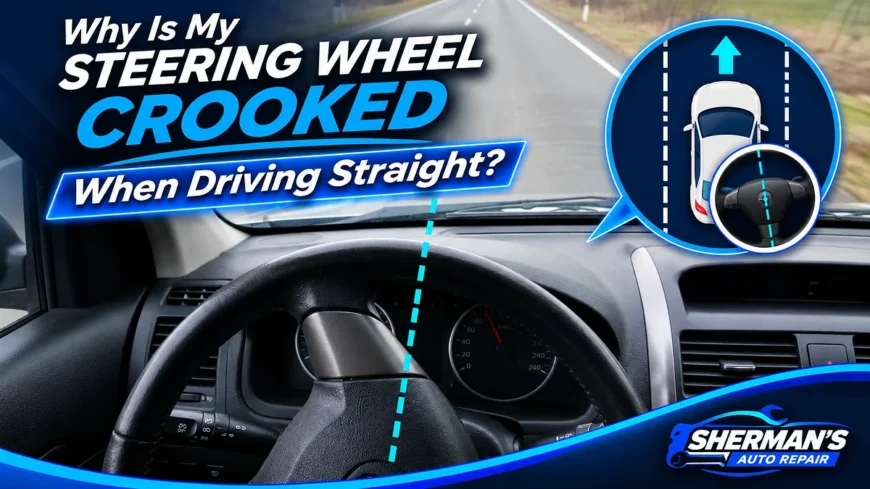

Your car is moving straight down the road, but your steering wheel is sitting slightly to the left or right instead of being centered. You straighten the wheel, and the vehicle starts moving toward one side of the lane.
It’s frustrating, especially when the car seems to drive normally otherwise. But is a crooked steering wheel just an alignment problem, or could something be wrong with your steering or suspension?
A crooked steering wheel while driving straight is commonly caused by incorrect wheel alignment or improper steering wheel centering during an alignment. However, worn tie rods, damaged control arms, tire problems, and rear-wheel alignment issues can also contribute.
Here’s where the diagnosis gets important: a steering wheel that’s off-center isn’t necessarily the same problem as a vehicle that pulls to one side.
If your car travels straight but the steering wheel sits at an angle, the first things to investigate are the alignment settings and steering wheel centering. If the vehicle constantly tries to drift left or right, the diagnosis also needs to consider tire forces, suspension condition, brakes, and road conditions.
Understanding that difference can save you from paying for an alignment that doesn’t fix the actual problem.
First, Is Your Steering Wheel Crooked, or Is Your Car Pulling to One Side?
Before looking at individual parts, a mechanic needs to understand exactly what the vehicle is doing.
These two situations may feel similar from the driver’s seat, but they don’t always have the same cause.
Situation 1: Your Car Drives Straight, but the Steering Wheel Is Off-Center
Imagine you’re driving on a relatively straight, level road. The vehicle maintains its direction with normal steering corrections, but the steering wheel stays slightly turned to one side.
You aren’t fighting a strong pull. The wheel simply isn’t centered where it should be.
That often points toward incorrect steering wheel centering relative to the front toe settings.
This can happen when the front wheels are adjusted without the steering wheel being properly centered, or when the steering geometry has changed after a repair.
The vehicle may track straight, yet the steering wheel remains crooked.
Situation 2: Your Steering Wheel Is Crooked Because You’re Correcting a Pull
Now consider a vehicle that constantly wants to drift right.
To keep it moving straight, you may find yourself applying a little left steering input.
The steering wheel appears off-center, but you’re actually using it to compensate for a pulling force.
That force might come from incorrect camber or caster, tire characteristics, unequal tire pressure, brake drag, or another mechanical issue.
Simply centering the steering wheel won’t remove the force that’s making the vehicle pull.
The important difference: In the first situation, the steering wheel position may be the primary problem. In the second, the wheel position may be a symptom of something else.
A proper diagnosis begins by distinguishing between them.
1. Incorrect Wheel Alignment: One of the Most Common Causes
When a steering wheel is crooked while the vehicle travels straight, wheel alignment is one of the first things worth checking.
Your vehicle has specific alignment angles that determine how the wheels contact the road and how the steering responds.
Three of the most important are toe, camber, and caster.
Toe describes whether the wheels point inward or outward when viewed from above.
Camber describes how much the wheels tilt inward or outward when viewed from the front.
Caster describes the angle of the steering axis when viewed from the side and influences steering stability and return-to-center.
For a crooked steering wheel, front toe and steering wheel centering are particularly important.
How Front Toe Can Leave Your Steering Wheel Crooked
On most modern passenger vehicles, the front toe settings are adjusted through the tie rods.
Here’s a situation worth understanding.
A vehicle can have an acceptable total front toe measurement while the individual left and right toe settings aren’t correctly established relative to the centered steering wheel and the vehicle’s direction of travel.
For example, if the steering wheel wasn’t held in the correct straight-ahead position during an alignment, the technician could finish adjusting the toe while the steering wheel was slightly turned.
The car might drive straight afterward, but the steering wheel could remain noticeably off-center.
That’s why a proper alignment isn’t simply about getting the total toe measurement within specification.
The technician also needs to center the steering system correctly, account for the vehicle’s thrust line, and verify the steering wheel position afterward.
What Should Be Done?
A technician should measure the alignment, confirm the steering wheel is correctly centered, and inspect whether any steering or suspension component is affecting the readings.
If the mechanical components are in good condition, the appropriate adjustments can be made to restore correct alignment and steering wheel centering.
The repair should finish with verification that the steering wheel sits correctly when the vehicle travels straight.
2. Bent or Worn Tie Rods Can Affect Steering Wheel Position
Tie rods are another important part of this diagnosis.
They connect the steering system to the steering knuckles, allowing the front wheels to respond when you turn the steering wheel.
They also help establish front toe.
If a tie rod becomes bent or develops excessive looseness, it can affect the position of the wheel.
What Happens When a Tie Rod Gets Bent?
Suppose the front wheel takes a hard hit against a curb or drops into a deep pothole.
That impact can transfer considerable force into the steering and suspension.
If the tie rod bends, its effective geometry changes, which can alter toe.
The driver may notice that the steering wheel suddenly sits at a different angle than before the impact.
The vehicle may also begin pulling, feel less stable, or develop uneven tire wear.
A bent tie rod isn’t something that should be corrected by adjusting the alignment around the damaged part.
The damaged component needs to be inspected and repaired or replaced before the final alignment is performed.
What About a Loose Tie Rod End?
A worn tie rod end presents a different problem.
Instead of holding the steering knuckle securely, the joint may allow unwanted movement.
That can make steering feel loose or imprecise.
It may also allow toe to vary as the vehicle moves, particularly when the load on the tires changes.
An alignment adjustment cannot remove that mechanical looseness.
What you should do: If the steering wheel became crooked after hitting a curb or pothole, or the steering now feels loose, have the steering linkage inspected before assuming a routine alignment is all that’s needed.
3. Worn Control Arms, Bushings, or Ball Joints
Your control arms and ball joints help maintain the position of the wheels as the suspension moves.
The control arms connect the suspension to the vehicle structure. Their bushings allow controlled movement while keeping the arms properly located.
Ball joints connect the control arms to the steering knuckles and allow steering and suspension movement.
When these components are working correctly, the suspension maintains the intended geometry.
When they’re badly worn or damaged, that geometry may no longer remain consistent.
How a Worn Control Arm Bushing Can Affect Steering
Consider a control arm bushing that has deteriorated enough to allow excessive movement.
Under braking, acceleration, or cornering, the control arm may shift farther than intended.
That movement can change the wheel’s position under load.
Depending on the suspension design, the driver might notice wandering, unstable steering, or a pull that changes with vehicle movement.
The car may not behave exactly the same during acceleration as it does while coasting or braking.
That kind of changing steering behavior deserves a mechanical inspection.
It shouldn’t automatically be treated as a simple toe adjustment.
Can a Bad Ball Joint Make the Steering Wheel Crooked?
A severely worn ball joint can affect how securely the steering knuckle is located and may contribute to unstable handling or changing wheel alignment angles.
However, a crooked steering wheel by itself doesn’t prove a ball joint is bad.
The technician needs to inspect for excessive joint play, damaged mounting points, or other suspension problems before recommending replacement.
The solution: Repair the damaged or worn components first, then check the wheel alignment.
Trying to align a vehicle while suspension components are moving excessively may leave the original handling problem unresolved.
4. Tire Problems Can Make You Hold the Steering Wheel at an Angle
Here’s something many drivers overlook: not every steering pull comes from wheel alignment.
Tires can create directional forces of their own.
In fact, tire condition and pressure should be among the first things checked when a vehicle pulls to one side.
Unequal Tire Pressure
If one front tire is significantly underinflated compared with the other, the difference can affect how the vehicle tracks.
You may find yourself applying steering input to keep the car moving straight.
Before assuming that the alignment is incorrect, check the tire pressures when the tires are cold.
Use the recommended inflation pressures on the vehicle’s tire information placard, commonly located near the driver’s door, or in the owner’s manual.
Don’t use the maximum pressure printed on the tire sidewall as the normal inflation target.
If correcting the pressure resolves the problem, an alignment adjustment may not be necessary for that particular complaint.
If the tire continues losing pressure, the leak needs to be diagnosed.
Tire Conicity: When the Tire Itself Creates a Pull
A tire can generate a sideways force because of its construction or shape, even when the alignment measurements are within specification.
One possible cause is tire conicity.
The term describes a tire characteristic that makes it behave somewhat like a cone rather than rolling with perfectly uniform lateral forces.
In practical terms, one tire may encourage the vehicle to pull toward one side.
This is especially worth considering when a pulling problem appears immediately after installing new tires or rotating existing tires.
A technician can investigate this by checking the tires, verifying alignment, and performing appropriate tire-position diagnostic tests when permitted by the tire design and manufacturer requirements.
Why This Matters Before Paying for an Alignment
Imagine that your car begins pulling right immediately after new tires are installed.
If the actual cause is a tire-generated lateral force, adjusting the alignment to compensate for that pull could introduce incorrect alignment angles.
You might end up with a vehicle that feels better temporarily but has settings that don’t match the manufacturer’s intended specifications.
The right diagnosis is to identify whether the pull comes from the tires or the alignment before making corrections.
What you should do: If the crooked steering wheel or pulling started after a tire change or rotation, tell the mechanic exactly when it began. That information can help narrow down the cause.
5. A Bent Control Arm or Other Suspension Damage After Hitting a Pothole
If your steering wheel suddenly became crooked after a hard impact, the cause may be more serious than a normal alignment change.
A curb strike or severe pothole impact can damage components that control wheel position.
Possible damage includes a bent tie rod, control arm, steering knuckle, wheel, or another suspension component.
In some cases, the impact may also damage a tire internally, even if the outside looks relatively normal.
Why Alignment Alone May Not Solve It
An alignment machine can measure wheel angles, but it cannot straighten a bent control arm or repair damaged steering components.
If a mounting point or suspension component has changed shape, the technician may find that an alignment angle remains outside specification even after the available adjustments are made.
That’s a sign the underlying geometry needs further investigation.
The correct repair might involve replacing damaged components, checking mounting locations, and then performing a final alignment.
What you should do: If the steering wheel position changed suddenly after an impact, schedule a steering and suspension inspection promptly. If the vehicle pulls severely, feels unstable, or has visible tire or wheel damage, avoid driving it and arrange professional assistance.
6. Rear Wheel Alignment Can Affect Your Front Steering Wheel
It’s easy to focus entirely on the front wheels because they’re the ones you turn.
But the rear wheels also influence the direction in which the vehicle travels.
One measurement that matters is the rear thrust angle.
This describes the direction the rear wheels collectively point relative to the vehicle’s geometric centerline.
If the rear wheels aren’t tracking in the intended direction, the driver may need to use a slight amount of steering input to keep the car traveling straight.
That can contribute to an off-center steering wheel, even when the immediate complaint seems to involve the front end.
Why a Front-Only Alignment Might Miss the Problem
Suppose the front toe is adjusted without evaluating the rear thrust angle.
The front wheel measurements might appear acceptable, but the relationship between the front and rear wheels may still need attention.
This is one reason a four-wheel alignment measurement can be useful.
It allows the technician to evaluate how the front and rear wheel angles relate to each other.
Not every vehicle has adjustable rear suspension angles, though. If the rear readings are outside specification and no adjustment is available, the cause may require further diagnosis.
The solution: When a crooked steering wheel persists after front-end alignment, ask whether rear toe and thrust angle were measured.
7. The Steering Wheel May Not Have Been Centered Correctly During a Previous Alignment
If your steering wheel was straight before an alignment and crooked immediately afterward, the previous alignment procedure deserves another look.
A professional alignment should address both the wheel angles and the steering wheel’s straight-ahead position.
That means the steering wheel needs to be properly centered during the relevant adjustments, and the finished result needs to be verified.
Why the Alignment Printout Might Look Correct
An alignment printout can show measurements within specification while the steering wheel still sits off-center.
That may happen if the steering wheel wasn’t correctly positioned during the adjustment or if the individual toe settings weren’t properly established relative to the vehicle’s straight-ahead direction.
A printout is valuable, but it isn’t the only part of verifying the repair.
The technician also needs to confirm the steering wheel is centered during normal straight-line driving.
Should You Just Remove and Reposition the Steering Wheel?
Generally, no.
If the steering wheel is crooked because the toe settings or steering geometry are incorrect, removing and repositioning the steering wheel doesn’t correct the underlying alignment problem.
Modern steering systems may also include airbag components, steering angle sensors, clock springs, and other parts that require specific service procedures.
There are exceptions involving incorrectly assembled steering components, but that needs to be diagnosed properly.
What you should do: If the steering wheel became crooked immediately after an alignment, contact the shop that performed the work. Ask them to recheck steering wheel centering, individual toe settings, and the vehicle’s alignment measurements.
Could It Be Something Other Than Alignment or Suspension?
Yes. Sometimes the way the vehicle pulls gives a mechanic a useful clue.
For example, if the vehicle drives normally until you apply the brakes, but then pulls sharply to one side, the braking system deserves attention.
A sticking brake caliper, uneven braking force, or another brake-related condition can create a directional pull.
Road slope can also affect how a vehicle tracks.
Many roads are built with a slight slope to help water drain. This is known as road crown.
On some roads, a mild drift toward the lower side may occur even when the vehicle is mechanically sound.
That doesn’t mean every pull is normal, and it shouldn’t be used as an excuse to ignore a persistent handling problem.
The technician needs to consider road conditions while evaluating the symptom.
Another distinction is steering wheel vibration.
If the wheel shakes at certain speeds but isn’t consistently crooked, the concern may involve tire or wheel imbalance, wheel damage, tire defects, or other mechanical issues rather than alignment alone.
These symptoms can overlap, but they shouldn’t all receive the same repair.
What Should You Do If Your Steering Wheel Is Crooked?
You don’t need to diagnose the entire steering system yourself. However, a few observations can help your mechanic identify the problem faster.
| What you notice | What to do next |
|---|---|
| Car drives straight, but the wheel stays crooked | Request an alignment and steering wheel centering check |
| Car consistently pulls left or right | Have tire pressures, tire condition, alignment, and suspension inspected |
| Problem began after a tire replacement or rotation | Have the shop evaluate possible tire-related pulling forces |
| Problem began after a wheel alignment | Return for a steering wheel centering and alignment verification |
| Problem appeared after hitting a pothole or curb | Request an inspection for wheel, tire, steering, and suspension damage |
| Vehicle pulls mainly while braking | Have the braking system inspected |
| Steering feels loose, unstable, or unpredictable | Avoid further driving until the vehicle’s safety has been assessed |
Three Things You Can Check Before Visiting the Shop
First, check your tire pressures. When the tires are cold, compare their pressures with the vehicle manufacturer’s recommendations.
Second, look for obvious tire damage. Check for unusual tread wear, visible sidewall bulges, cuts, or an obviously damaged wheel. Don’t drive on a tire with a suspected structural problem.
Third, think about when the problem started. Did it happen after an alignment, after installing new tires, or after hitting something in the road? Did it develop gradually?
That information often gives the technician a more useful starting point than simply saying the car needs an alignment.
Don’t release the steering wheel while driving to test whether the vehicle pulls. Keep control of the vehicle and describe the symptoms you notice during normal driving. A qualified technician can perform the appropriate road test.
How a Mechanic Should Diagnose a Crooked Steering Wheel
A proper diagnosis should answer two questions: Why is the steering wheel off-center, and what needs to be corrected to restore normal steering?
The process starts with confirming the customer’s concern.
Step 1: Confirm the Steering Behavior
A controlled road test can help determine whether the vehicle tracks straight with an off-center steering wheel, develops a consistent pull, or has an intermittent steering issue.
The technician should also consider road conditions, when the symptom occurs, and whether braking or acceleration changes the behavior.
Step 2: Inspect the Tires and Wheels
The tires should be checked for correct inflation, matching applications, uneven wear, and signs of damage.
A tire-generated pulling force may need investigation, particularly when the complaint started after tire work.
This step matters because an alignment adjustment cannot fix every tire-related problem.
Step 3: Inspect the Steering and Suspension
The technician should check relevant steering and suspension components for looseness, wear, damage, or improper installation.
That may include tie rods, ball joints, control arms, bushings, steering linkage, and applicable mounting points.
If a component is bent or excessively worn, it needs to be addressed before relying on the final alignment measurements.
Step 4: Measure the Wheel Alignment
Alignment equipment measures the wheel angles and compares them with the specifications for the vehicle.
Important readings include individual front toe, total toe, camber, caster where applicable, and rear alignment measurements such as thrust angle.
The technician then determines which readings need correction and whether the vehicle provides the necessary adjustments.
Step 5: Correct the Cause and Verify the Result
If alignment is the cause, the necessary adjustments should be completed with the steering wheel correctly centered.
If damaged components or tire conditions are responsible, those issues need to be addressed rather than hidden by changing alignment settings.
Afterward, the vehicle’s steering wheel position and road behavior should be checked.
Some vehicles may also require a steering angle sensor calibration or another manufacturer-specified procedure, depending on the work performed and the systems installed.
The point of the diagnosis is not just to make the steering wheel appear straight. It’s to restore correct wheel geometry, stable handling, and proper steering operation.
Is It Safe to Drive With a Crooked Steering Wheel?
That depends on what’s causing it.
A slightly off-center steering wheel on an otherwise stable vehicle may not indicate an immediate mechanical emergency.
However, the condition should still be checked because incorrect alignment can contribute to tire wear, and a steering wheel position change may reflect an underlying problem.
The concern becomes more serious when the crooked steering wheel is accompanied by:
- Sudden or severe pulling to one side.
- Excessive steering looseness or unpredictable response.
- A recent hard impact against a curb or pothole.
- Loud clunking or obvious suspension damage.
- A visibly damaged wheel or tire.
- A significant change in handling immediately after steering or suspension repairs.
If any of these are present, stop in a safe location and arrange professional evaluation. Towing may be the safer option.
Don’t continue driving a vehicle that feels difficult to control just to reach an alignment shop.
How Much Does It Cost to Fix a Crooked Steering Wheel?
The cost depends on the actual cause.
If the problem is simply incorrect steering wheel centering during a recent alignment, the shop may be able to correct it through the appropriate alignment procedure.
If the problem comes from a bent tie rod, worn control arm, damaged tire, or another mechanical issue, the required repair will be different.
That’s why quoting one price for every crooked steering wheel complaint isn’t useful.
A wheel alignment and a suspension repair are not interchangeable services.
Before approving repairs, ask the shop what caused the steering wheel to be off-center, what measurements or inspection findings support that diagnosis, and what work is necessary to correct it.
If the alignment has already been checked and the readings are within specification, ask what other causes have been ruled out before paying for another adjustment.
Frequently Asked Questions
Why Is My Steering Wheel Turned Left When My Car Goes Straight?
Your front toe settings or steering wheel centering may be incorrect, particularly if the car tracks straight without a significant pull. A tire-related force or rear thrust-angle issue can also require steering correction. An alignment and steering inspection can identify the cause.
Why Is My Steering Wheel Crooked After an Alignment?
The steering wheel may not have been properly centered during the adjustment, or the final alignment may not have accounted correctly for the vehicle’s direction of travel. Return to the repair shop and ask them to verify the steering wheel position and alignment readings.
Can Bad Tires Cause a Crooked Steering Wheel?
Yes, indirectly. Unequal tire pressures, uneven wear, or tire-generated lateral forces can cause a vehicle to pull, requiring the driver to hold the steering wheel at an angle to maintain a straight path.
Can a Bad Tie Rod Make My Steering Wheel Crooked?
Yes. A bent tie rod can change toe, while a worn tie rod end can create looseness and unstable steering. Damaged or worn steering components should be repaired before the final alignment.
Will a Wheel Alignment Straighten My Steering Wheel?
If the problem comes from incorrect wheel alignment or steering wheel centering, a properly performed alignment can often correct it. If the underlying problem is a damaged component, tire issue, or another mechanical condition, additional diagnosis or repair may be needed.
Can a Pothole Make Your Steering Wheel Crooked?
Yes. A hard impact can change alignment or damage steering, suspension, tire, or wheel components. A sudden steering wheel position change after an impact should be inspected rather than dismissed as normal wear.
Why Does My Car Pull Right Even After an Alignment?
Possible causes include tire-generated lateral forces, uneven tire pressure, brake drag, damaged suspension components, or alignment settings that still need correction. The technician should verify the alignment results and investigate other sources of pulling instead of automatically repeating the same adjustment.
Can a Crooked Steering Wheel Cause Uneven Tire Wear?
The crooked position itself doesn’t necessarily cause tire wear. However, incorrect toe or other misalignment responsible for that position can cause premature or uneven tire wear.
The Bottom Line: Don’t Just Straighten the Wheel—Find Out Why It’s Crooked
When your steering wheel doesn’t sit straight while driving, a wheel alignment is one of the first things worth investigating.
But the steering wheel position alone doesn’t tell the whole story.
If your vehicle travels straight with the wheel off-center, the issue may involve front toe settings or steering wheel centering.
If the vehicle actively pulls left or right, the diagnosis needs to go further. Tire condition, tire-generated forces, suspension wear, damaged steering components, brakes, and rear alignment can all play a role.
And if the problem appeared after an impact or recent repair, that history matters.
The right solution is to find the cause of the crooked steering wheel—not simply adjust something until the symptom seems less noticeable.
That’s how you avoid unnecessary repairs, protect your tires, and restore the predictable steering your vehicle was designed to provide.
Crooked Steering Wheel? Get Your Steering and Alignment Checked in Sarasota, FL
If your steering wheel is off-center, your vehicle pulls to one side, or the steering doesn’t feel the way it used to, Sherman’s Auto Repair can help identify the cause.
At Sherman's Auto Repair in Sarasota, FL, our ASE-certified technicians provide wheel alignment services and steering and suspension diagnostics.
Whether the problem involves incorrect toe settings, worn steering components, damaged control arms, or another issue affecting vehicle handling, the goal is to identify what actually needs attention.
You can learn more about our Wheel Alignment Services in Sarasota and Steering and Suspension Repair Services.
Visit Sherman’s Auto Repair
757 Gantt Ave Suite 9, Sarasota, FL 34232
Call: (941) 444-7057
Hours: Monday–Friday, 9:00 AM–6:00 PM
Let’s Find Out Why Your Steering Wheel Isn’t Straight
Tell us whether your steering wheel stays crooked while driving straight, your vehicle pulls to one side, or the problem began after recent tire, alignment, or suspension work.
We’ll help determine the appropriate inspection and repair based on what your vehicle is actually doing.

