
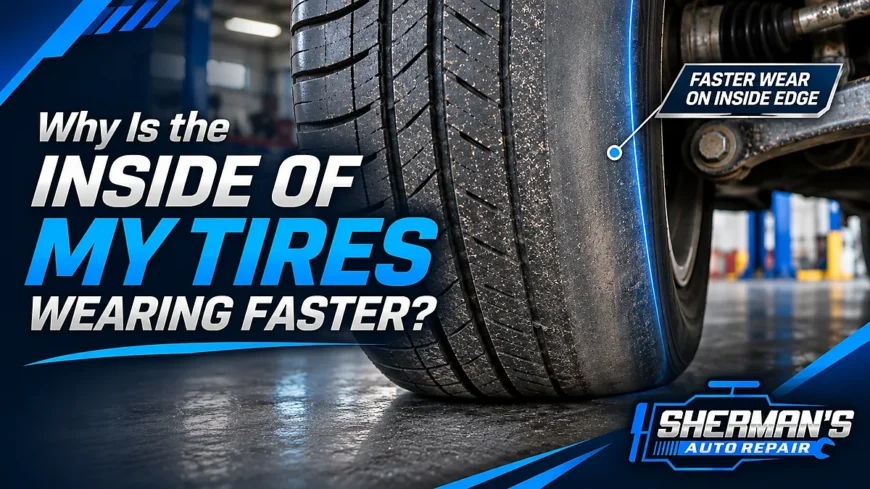

You look at your tires, and the tread on the outside still seems to be in good condition. But when you look closer at the inner edges, you notice something different. The tread is wearing down much faster, and in some areas, it may be almost completely gone.
How can one side of a tire be so worn when the rest still has plenty of tread?
If the inside of your tires is wearing faster than the outside, the most likely causes involve wheel alignment—particularly excessive negative camber, incorrect toe, or a combination of both. Worn steering and suspension components can also allow the wheel angles to change, causing the inner tread to wear prematurely.
However, the wear pattern alone doesn’t tell you exactly which component or adjustment is responsible.
A tire worn smoothly along its inner shoulder may point toward excessive camber. Feathered tread or severe inner-edge scrubbing may indicate a toe problem. And if the wheel’s position changes as you drive because of worn control arm bushings or loose steering components, correcting the alignment without repairing those parts may not solve the problem.
The important thing is to find out why the tire is wearing unevenly before installing new tires or paying for an alignment.
Here’s how to recognize the different wear patterns, understand what causes them, and determine what needs to be checked.
What Does Inside Tire Wear Actually Mean?
Inside tire wear occurs when the tread closest to the center of the vehicle wears faster than the rest of the tire.
For example, the outer tread may still have visible grooves, while the innermost shoulder is worn smooth.
This can happen on front tires, rear tires, or both.
And because the inner shoulder faces underneath the vehicle, the damage is sometimes difficult to notice during a normal walk-around inspection.
You might see plenty of tread when looking at the outside of the tire and assume the entire tire is in similar condition.
But the inside shoulder may be much more worn.
Why the Wear Pattern Matters
Before recommending an alignment, a mechanic should determine where and how the tire is wearing.
Is the wear concentrated in a narrow band along the innermost edge?
Does the tread become progressively thinner from the outside toward the inside?
Do the tread blocks have a sharp edge when examined in one direction and a rounded edge in the other?
Or does the tire have uneven, scalloped patches rather than one continuous worn strip?
These differences matter because camber wear, toe wear, and irregular wear from suspension movement don’t always look the same.
The wear pattern helps guide the inspection, but the final diagnosis comes from measuring the alignment and checking the mechanical components.
1. Excessive Negative Camber Can Wear Down the Inside of Your Tires
One of the first alignment measurements to consider with inner-edge tire wear is camber.
Camber describes how much the wheel tilts inward or outward when viewed from the front or rear of the vehicle.
When the top of the wheel tilts inward toward the vehicle, it has negative camber.
When the top tilts outward, it has positive camber.
A certain amount of negative camber is normal on many vehicles. Manufacturers use specific camber settings to balance handling, stability, and tire performance.
The problem occurs when the negative camber is excessive for the vehicle or its operating conditions.
How Negative Camber Wears the Inner Shoulder
Imagine the top of the tire leaning inward more than the manufacturer intended.
That angle changes how the tread is loaded against the road.
During ordinary straight-line driving, the inner portion of the tire may carry more of the contact load than it should.
Over time, the inner shoulder can wear faster than the center or outside of the tread.
This often produces a relatively smooth wear pattern that becomes more pronounced toward the inner edge.
But here’s something important: negative camber isn’t automatically a problem.
Many vehicles are designed to operate with some negative camber, and certain performance-oriented vehicles use more of it to support cornering.
The mechanic needs to compare the actual measurement against the correct specifications for your vehicle—not simply assume that any inward wheel tilt is excessive.
What Causes Camber to Become Incorrect?
Several conditions can change camber, including:
- A bent control arm or steering knuckle.
- Worn or damaged suspension components.
- Sagging springs or an incorrect ride height.
- Suspension modifications that change vehicle height.
- A previous repair involving alignment-sensitive mounting points.
- Damage from a pothole or curb impact.
Not every vehicle has a factory-provided camber adjustment.
If camber is outside specification and can’t be corrected using approved adjustments, the technician may need to investigate damaged components, ride height, or other suspension problems.
What you should do: If the inside edge is wearing smoothly and progressively, have camber measured along with toe. Don’t assume a camber adjustment alone will solve the problem until the other alignment angles and suspension condition have been evaluated.
2. Incorrect Toe Can Destroy Inner Tire Tread Even When Camber Looks Acceptable
Toe is another major cause of abnormal tire wear—and it’s particularly important because toe-related wear can be mistaken for camber wear.
Toe describes the direction the tires point relative to each other when viewed from above.
If the fronts of the tires point slightly toward each other, that’s toe-in.
If they point away from each other, that’s toe-out.
The vehicle manufacturer specifies the appropriate toe settings for the suspension design.
Why Incorrect Toe Causes Tire Scrubbing
Your tires are supposed to roll in the intended direction of travel.
When toe is incorrect, the tires may be pointed slightly away from that direction.
As the vehicle moves forward, the tread is forced to scrub sideways against the pavement.
The driver may not notice a significant steering problem, but the tires experience that scrubbing continuously.
Depending on the toe settings, camber, and other factors, the wear can become concentrated toward one shoulder.
Excessive toe-out can contribute to inner-edge wear, but tire wear is not determined by toe direction alone. The final pattern depends on how the alignment angles interact.
How Toe Wear Differs From Camber Wear
A useful clue is the surface of the tread.
With camber-related wear, the tread may show a relatively smooth, progressive reduction toward one shoulder.
With toe-related wear, the tread blocks may develop feathering.
Feathering occurs when one edge of a tread block becomes rounded while the opposite edge remains comparatively sharp.
This happens because the tread is repeatedly dragged or scrubbed against the road.
A technician can inspect the direction and distribution of that wear to help determine whether toe is involved.
However, once the tread becomes severely worn, the original pattern may be difficult to distinguish.
That is why measuring the actual alignment angles is essential.
Can Toe Be Wrong Even If Your Car Drives Straight?
Yes.
A vehicle can travel in a relatively straight line while the front tires have excessive total toe.
The steering wheel may even appear centered.
The problem is that the tires are still scrubbing against the road as they roll.
You might not realize anything is wrong until the inner tread is nearly worn away.
What you should do: If your tires are wearing rapidly along the inner edge, ask the technician to evaluate individual toe, total toe, and camber—not just whether the steering wheel is straight.
3. Worn Control Arm Bushings Can Make Inner Tire Wear Keep Coming Back
Sometimes a wheel alignment is performed correctly, but the vehicle continues wearing its tires unevenly.
When that happens, the mechanic needs to consider whether the suspension components can actually maintain the intended wheel positions during driving.
Control arm bushings are one place to investigate.
These bushings connect the control arms to the vehicle structure while allowing controlled suspension movement.
Over time, they can deteriorate, tear, or develop excessive movement.
How a Bad Control Arm Bushing Affects Tire Wear
Consider a control arm bushing that’s worn enough to allow more movement than intended.
When the vehicle is stationary on an alignment rack, the wheel angles may measure within specification.
But when the vehicle accelerates, brakes, or travels over bumps, the forces acting on the control arm change.
The worn bushing can allow the arm to move excessively.
Depending on the suspension design, that movement can change the wheel’s toe or camber while the vehicle is driving.
The alignment machine may have measured one position, while the tire experiences a different geometry under load.
That can explain why abnormal tire wear sometimes continues even after an alignment.
Why Another Alignment May Not Fix It
If the control arm is moving because of a worn bushing, adjusting the alignment doesn’t repair the bushing.
The underlying mechanical problem needs to be addressed.
Once the worn component has been repaired or replaced, the final alignment can be checked and adjusted according to the manufacturer’s specifications.
What you should do: If your inner tires continue wearing despite an alignment, ask whether the control arm bushings and other wheel-locating suspension components have been inspected for excessive movement.
4. Worn Tie Rods or Ball Joints Can Contribute to Uneven Tire Wear
Tie rods and ball joints are also important to examine when tires wear abnormally.
Tie rods connect the steering system to the steering knuckles and help establish front toe.
Ball joints connect suspension components while allowing the wheels to steer and move with the suspension.
Both need to maintain their intended positions without excessive looseness.
How a Worn Tie Rod Affects Toe
A loose inner or outer tie rod can allow unwanted steering linkage movement.
Depending on the degree of wear, the front toe may vary as driving forces change.
That can contribute to irregular tire wear and imprecise steering.
An alignment adjustment cannot remove looseness from a worn tie rod end.
If a tie rod is excessively worn, it needs to be replaced before the final alignment.
Can a Worn Ball Joint Cause Inner Tire Wear?
It can contribute, especially if it has enough play to affect how securely the steering knuckle is located.
However, inner tire wear alone doesn’t prove that a ball joint is defective.
The mechanic should verify excessive joint play or other damage before recommending replacement.
The same applies to control arms, steering knuckles, and other suspension components.
The correct repair is based on the condition of the part—not simply the appearance of the tire.
5. Lowered Suspension or Incorrect Ride Height Can Change Tire Wear
If your car has been lowered or its suspension height has changed, that information matters during diagnosis.
Suspension geometry is designed to operate within a particular range of ride heights.
When the vehicle sits lower or higher than intended, the angles of the control arms and other suspension components change.
Depending on the suspension design, this can affect both camber and toe.
Why Lowered Cars Often Develop Inner Tire Wear
On some vehicles, lowering the suspension increases negative camber.
If camber becomes excessive, the inside shoulder may carry more load during ordinary driving.
But there’s a second concern.
Lowering a vehicle can also change toe, and incorrect toe may accelerate wear considerably.
This is why adjusting camber without checking toe may not resolve the issue.
Some lowered vehicles also lack sufficient factory adjustment range to restore the desired alignment settings.
In those situations, a vehicle-specific, approved alignment solution may be required.
What If Your Vehicle Hasn’t Been Modified?
Ride-height problems can still occur on an unmodified vehicle.
Worn or sagging springs, damaged suspension components, or incorrect replacement parts can alter how the vehicle sits.
A technician should evaluate ride height when the alignment measurements suggest that suspension geometry may have changed.
What you should do: If inner tire wear began after lowering the vehicle, installing suspension parts, or noticing a ride-height change, have the alignment and suspension geometry checked using the appropriate vehicle specifications.
6. Why Are My Rear Tires Wearing on the Inside?
Inner-edge wear isn’t limited to the front tires.
Rear tires can develop the same problem, and the cause may involve rear suspension geometry rather than the front steering system.
On vehicles with independent rear suspension, rear toe and camber are particularly important.
How Rear Toe Causes Tire Wear
Rear wheels don’t steer in the same way as the front wheels on most passenger vehicles, but their alignment still determines how they roll down the road.
If rear toe is incorrect, a rear tire may scrub sideways as the vehicle moves.
That can create irregular wear, feathering, or wear concentrated toward one shoulder.
On some vehicles, rear toe is adjustable. On others, the available adjustments are limited.
If the measurements are incorrect and cannot be adjusted, the technician may need to inspect suspension links, bushings, ride height, or damage.
What If Both Rear Tires Are Wearing on the Inside?
If both rear tires show similar inner-edge wear, the technician should evaluate the rear alignment on both sides, including toe and camber.
Suspension geometry, ride height, and tire position history should also be considered.
However, two similarly worn rear tires don’t automatically prove that a particular rear suspension component has failed.
The alignment readings and mechanical inspection determine the next step.
What you should do: If the rear tires are wearing on their inside edges, request a four-wheel alignment evaluation rather than assuming a front-end alignment will address the problem.
7. Is Low Tire Pressure Causing My Inside Tire Wear?
Tire pressure should always be checked when diagnosing abnormal wear.
However, it’s important to understand the usual differences between tire-pressure wear and alignment-related wear.
Underinflation commonly causes increased wear on both shoulders of the tire.
Overinflation can contribute to increased wear through the center of the tread.
One-sided inner shoulder wear more strongly suggests investigating alignment, suspension geometry, or other uneven loading conditions.
That doesn’t mean tire pressure is irrelevant.
Incorrect inflation can worsen tire wear, handling, and heat buildup.
But adding or removing air won’t correct an excessive camber angle or loose control arm bushing.
What Pressure Should You Use?
Check tire pressure when the tires are cold.
Use the recommended inflation pressure listed on the vehicle’s tire information placard, usually located near the driver’s door, or in the owner’s manual.
Do not use the maximum pressure printed on the tire sidewall as the normal inflation target.
What you should do: Correct the tire pressures as part of the initial inspection, but don’t treat pressure adjustment as a substitute for diagnosing one-sided inner tread wear.
How to Tell What’s Causing Your Inside Tire Wear
A tire’s wear pattern can provide useful clues, but there isn’t a single visual test that identifies every alignment or suspension problem.
This guide can help you understand where the diagnosis should begin.
| What you notice | Possible explanation | What should be checked |
|---|---|---|
| Smooth wear concentrated on the inner shoulder | Excessive negative camber | Camber, toe, ride height, suspension geometry |
| Feathered tread blocks and rapid edge wear | Incorrect toe | Individual and total toe, steering components |
| Both front tires wearing on the inside | Front alignment or geometry issue | Front toe, camber, steering and suspension |
| Both rear tires wearing on the inside | Rear toe or camber problem | Rear alignment, bushings, suspension links |
| One tire wearing much faster than the others | Local alignment or mechanical problem | That wheel’s alignment, tire condition, suspension |
| Wear returns after an alignment | Remaining mechanical movement, incorrect settings, or pre-existing wear | Alignment report, bushings, ball joints, tie rods, tire history |
| Wavy or scalloped wear around the tire | Possible damping, balance, or suspension issue | Shocks/struts, tire-and-wheel assembly, suspension |
| Both shoulders wearing faster than the center | Underinflation or other loading conditions | Tire pressure, tire fitment, usage |
These patterns are starting points—not automatic diagnoses.
A mechanic should use them alongside alignment measurements and a physical inspection.
Is It Safe to Drive With the Inside of Your Tires Worn Down?
That depends on how much tread remains and whether the tire has structural damage.
But there’s a particular concern with inner-edge wear: the inside shoulder can be dangerously worn while the rest of the tire still looks usable.
You may see deep grooves across the outer tread and assume the tire has plenty of life remaining.
Meanwhile, the inner shoulder may already be smooth or worn through.
What If the Tire Cords Are Showing?
If you can see steel belts or other reinforcing cords through the worn tread, the tire is no longer suitable for use.
Do not continue driving on it.
Arrange for a suitable spare, roadside assistance, or professional tire replacement.
Exposed cords indicate that the tread rubber has worn through far enough to reveal the tire’s underlying structure.
An alignment will not make that tire safe again.
What If the Inner Tread Is Almost Bald?
Even if the cords aren’t visible, severely reduced tread depth is a safety concern.
For passenger tires, NHTSA identifies 2/32 of an inch as the point at which tires should be replaced.
Michelin also recommends replacement when tread depth reaches that level in any groove or when reinforcing cords are exposed.
A tire with heavily worn inner tread may have substantially reduced traction, particularly on wet pavement.
In Sarasota, where drivers can encounter heavy rain and standing water, maintaining adequate tire tread is especially important.
If the innermost tread is severely worn, don’t wait for the outer tread to catch up. Have the tire inspected and replaced when necessary.
Can You Fix Inner Tire Wear With Just a Wheel Alignment?
Sometimes an alignment is the main corrective service needed.
But not always.
If the steering and suspension components are in good condition and the alignment measurements are simply outside specification, appropriate adjustments may correct the cause of the wear.
However, an alignment won’t repair a bent control arm, worn tie rod, loose ball joint, or deteriorated control arm bushing.
And it cannot restore tread that has already worn away.
Will the Tire Wear Evenly Again After Alignment?
Correcting the underlying problem can prevent continued abnormal wear from the same cause.
But the existing wear pattern remains.
If the inner shoulder is already worn significantly thinner than the rest of the tire, an alignment won’t rebuild that rubber.
The tire may still require replacement depending on its remaining tread depth and condition.
Even when the tire remains serviceable, its previous wear pattern may affect its appearance or behavior until it is eventually replaced.
Should You Replace the Tires Before or After the Alignment?
The important goal is to correct the cause before putting unnecessary wear on new tires.
If the current tires are structurally sound and suitable for inspection, the technician can evaluate the suspension and alignment before replacement.
If the tires are unsafe, they need to be replaced before the vehicle returns to service or undergoes a road test.
A practical repair sequence is to inspect the tires and suspension, correct any damaged components, verify or adjust the alignment as required, and install safe tires as appropriate.
This helps avoid installing new tires while the condition that damaged the old ones remains unresolved.
What Should a Mechanic Check When Your Tires Wear on the Inside?
A proper diagnosis involves more than looking at the worn tread and immediately recommending alignment.
The technician needs to determine whether the problem comes from the wheel angles themselves or from components that are allowing those angles to change.
Step 1: Examine the Wear Pattern and Measure Tread Depth
The technician should compare the inner shoulder, center, and outer shoulder of the tire.
Tread depth should be checked at multiple suitable locations around the tire.
This helps determine whether the wear is concentrated along one edge, distributed across the tread, or irregular around the circumference.
The condition of all four tires should be considered.
If the tire is unsafe or the inner shoulder is difficult to inspect, the technician may need to remove the wheel for a more complete evaluation.
Step 2: Check Tire Pressure and Vehicle Ride Height
Tire pressures should be compared with the manufacturer’s recommendations.
The technician should also consider whether the vehicle is sitting at the correct ride height, especially if it has been lowered, modified, or fitted with replacement suspension components.
Ride height matters because alignment angles are affected by suspension position.
Step 3: Inspect the Steering and Suspension
Before making alignment adjustments, the technician should verify that the components responsible for locating the wheels are functioning correctly. For an explanation of related repairs, see steering and suspension repair.
Relevant parts may include:
- Inner and outer tie rods.
- Upper and lower ball joints.
- Control arms and their bushings.
- Struts, springs, and mounting points.
- Rear suspension links and bushings.
- Other wheel-locating components appropriate to the vehicle.
The objective is to identify excessive looseness, damage, or movement that could affect wheel position.
If a worn component is responsible, it should be addressed before the final alignment.
Step 4: Measure Camber and Toe on All Applicable Wheels
The technician should measure the wheel angles using alignment equipment and compare the results with the specifications for the vehicle’s year, make, model, and configuration. Our guide compares DIY wheel alignment with professional service.
For inner tire wear, camber and toe deserve particular attention.
Caster may also be evaluated as part of the alignment, but incorrect caster is not usually a primary cause of concentrated inner shoulder wear.
Rear toe, rear camber, and thrust angle should be considered where applicable.
Step 5: Interpret the Measurements Alongside the Wear Pattern
The diagnosis should not rely only on whether the alignment display shows green or red values.
For example, a vehicle may have camber toward the negative end of the acceptable range and a toe setting that also contributes to tread scrubbing.
The interaction between those settings, suspension condition, and vehicle usage can matter.
The technician should use the manufacturer’s specifications and service procedures to determine the appropriate settings rather than inventing a universal camber or toe target.
Step 6: Correct the Cause and Determine Whether the Tires Are Safe
If the alignment is incorrect and the components are sound, the appropriate adjustments can be made.
If suspension components are worn or damaged, those must be repaired.
The tires should then be evaluated for safe continued use or replacement.
After the repairs, the final alignment measurements and vehicle behavior should be verified.
The goal isn’t just to make the alignment printout look correct. It’s to identify why the inner tread wore prematurely and prevent the same condition from damaging the next set of tires.
Why Are My Tires Still Wearing on the Inside After an Alignment?
If you’ve already had a wheel alignment but continue noticing inner tire wear, don’t assume another alignment is automatically the answer.
Several possibilities deserve investigation.
First, the abnormal wear may have developed before the alignment. Correcting the wheel angles doesn’t erase existing wear.
Second, a worn suspension component may still be allowing the wheel position to change under driving loads.
Third, the alignment may not have addressed all relevant measurements, particularly rear toe or camber.
Fourth, the vehicle’s ride height or suspension modifications may prevent the desired alignment settings from being achieved through normal adjustments.
Finally, the previous readings may need to be reviewed to determine whether the relevant angles were properly evaluated and corrected.
What you should do: Ask the shop to review the previous alignment report, inspect the worn components, and determine whether the wear is old or actively progressing.
That is more useful than repeatedly paying for alignment without identifying the reason the tires continue wearing.
How to Prevent Inside Tire Wear From Ruining Your Next Set of Tires
Once the underlying problem is corrected, the next step is preventing it from returning.
The most useful habits are straightforward.
Inspect the full tire tread. Don’t judge tire condition only by the outside shoulder. Have the inner tread checked during routine service.
Maintain proper tire inflation. Check pressures at least monthly when the tires are cold. For additional guidance, see our basic tire maintenance tips.
Follow the appropriate tire rotation schedule. Rotation can help manage normal wear, but the pattern and interval depend on the vehicle and tire configuration.
Address steering and suspension looseness early. If the vehicle begins wandering, clunking, or handling differently, have it inspected.
Check alignment after relevant repairs or impacts. A hard curb strike, significant pothole impact, or replacement of certain suspension components may affect wheel geometry. Learn when an alignment is needed after steering or suspension repairs.
Investigate uneven wear before replacing tires. Installing new tires without correcting the original cause can lead to the same problem again.
The most effective way to protect tire life is to catch abnormal wear early, while there’s still enough tread remaining to identify the pattern and correct the cause.
Frequently Asked Questions
Why Are Both Front Tires Wearing on the Inside?
Both front tires wearing on their inner shoulders can indicate a front alignment issue involving toe, camber, or both. Suspension geometry and worn components may also contribute. A technician should measure the alignment and inspect the front suspension before determining the repair.
Why Is Only One Tire Wearing on the Inside?
One-sided wear on a single tire may involve that wheel’s camber or toe setting, a worn or bent suspension component, or a tire with an existing abnormal wear pattern. The affected wheel needs targeted inspection rather than assuming every wheel has the same problem.
Can Bad Toe Cause Inner Tire Wear?
Yes. Incorrect toe causes tread scrubbing because the wheel is not rolling in its intended direction. Depending on the alignment geometry, excessive toe-out and other toe conditions can contribute to inner-edge wear or feathering.
Does Negative Camber Always Cause Inner Tire Wear?
No. Some negative camber is normal and specified by the manufacturer. Excessive negative camber or certain driving conditions can concentrate wear on the inner shoulder. The appropriate setting depends on the vehicle.
Can Bad Shocks or Struts Cause Tires to Wear on the Inside?
They may contribute to irregular wear, particularly when suspension movement is poorly controlled or the strut is damaged or affects wheel geometry. However, cupping or scalloped wear is more characteristic of damping-related problems than a smooth, continuous strip of inner-edge wear. Camber and toe should still be checked.
Will a Tire Rotation Fix Inside Tire Wear?
A tire rotation won’t correct excessive camber, incorrect toe, or worn suspension components. It may help manage normal wear when the tires are still serviceable and the rotation pattern is appropriate, but the underlying problem should be corrected first.
Can Low Tire Pressure Cause Inside Tire Wear?
Incorrect tire pressure can contribute to abnormal tire wear, but underinflation more commonly affects both shoulders rather than just one inner edge. One-sided inner wear is a stronger reason to investigate alignment and suspension geometry.
Do I Need New Tires If the Inside Edge Is Bald?
If the inner tread has reached the replacement limit, has exposed reinforcing cords, or has structural damage, the tire needs replacement. Don’t rely on the remaining outer tread to determine whether it’s safe.
Can an Alignment Fix Inside Tire Wear Permanently?
An alignment can correct the wheel angles responsible for abnormal wear, provided the suspension components are sound and the settings can be brought within specification. It won’t restore already worn tread, and future suspension wear, impacts, or ride-height changes can affect alignment again.
The Bottom Line: Inner Tire Wear Is a Symptom—Find the Cause Before Replacing the Tires
If the inside of your tires is wearing faster than the rest, there’s a reason the tread isn’t being loaded or rolling evenly.
Excessive negative camber may be concentrating wear on the inner shoulder.
Incorrect toe may be scrubbing tread against the road.
Worn control arm bushings, loose tie rods, damaged ball joints, or other suspension problems may be allowing the wheel angles to change as you drive.
Sometimes more than one condition is contributing.
The right solution is to inspect the tire, measure the alignment, check the steering and suspension, and correct the actual cause.
Don’t replace a set of tires only to discover that the same alignment or suspension problem is still wearing down the new ones.
And don’t ignore severe inner-edge wear just because the outside of the tire looks fine.
Inner Tire Wear? Get Your Alignment and Suspension Checked in Sarasota, FL
If your tires are wearing down along the inside edges, it’s worth finding out why before the remaining tread is damaged.
At Sherman’s Auto Repair in Sarasota, FL, our ASE-certified technicians provide wheel alignment services, tire inspections, and steering and suspension diagnostics.
Whether the concern involves excessive camber, incorrect toe, worn control arm bushings, or another condition affecting tire wear, the first step is identifying what the vehicle actually needs.
We focus on evaluating the tire wear pattern, checking relevant components, and explaining the recommended repair based on the findings.
Learn more about our Wheel Alignment Services in Sarasota, Suspension Repair Services, and Tire Rotation Services.
Sherman’s Auto Repair
757 Gantt Ave Suite 9, Sarasota, FL 34232
Phone: (941) 444-7057
Business Hours: Monday–Friday, 9:00 AM–6:00 PM
Let’s Find Out Why Your Tires Are Wearing Unevenly
Tell us whether the inside wear is happening on the front tires, rear tires, or only one wheel. If you’ve recently had an alignment, suspension repair, or new tires installed, let us know.
Those details can help determine where the inspection should begin.

