
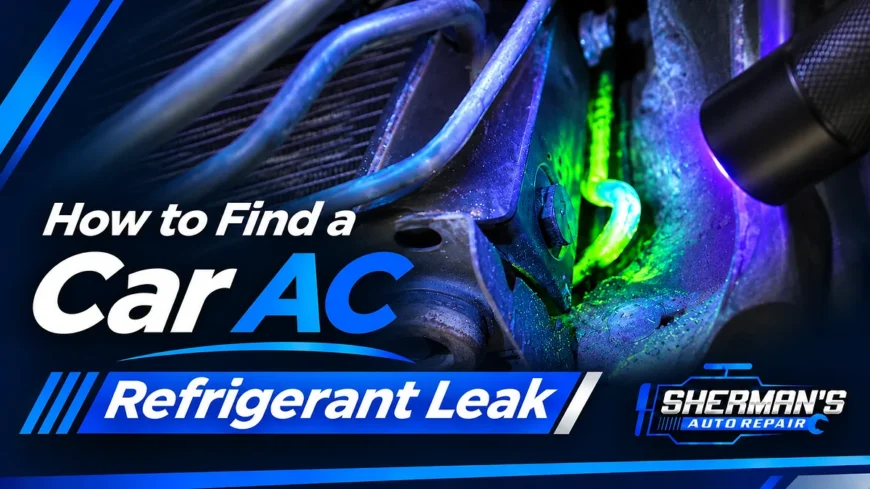

CAR AIR CONDITIONING / REFRIGERANT LEAK DETECTION GUIDE
To find a refrigerant leak in your car AC system, look for recurring cooling problems, inspect accessible components for oily residue or physical damage, and use appropriate leak detection methods such as UV dye inspection, electronic refrigerant detection, bubble testing or professional pressure testing. The most effective method depends on the location, size and nature of the leak.
Does your car’s air conditioning gradually become warmer, even after you’ve had the system recharged? Perhaps the AC worked perfectly for a few days before it started blowing warm air again.
A refrigerant leak could be responsible.
Your vehicle’s air conditioning system relies on a specific quantity of refrigerant to absorb heat from inside the passenger compartment and release it outside the vehicle. When refrigerant escapes, the system may gradually lose its ability to keep you comfortable.
Unfortunately, refrigerant leaks are not always easy to identify. Unlike an engine oil leak, a car AC refrigerant leak may leave little or no visible evidence. Some leaks develop around accessible connections, while others occur inside components concealed behind the dashboard.
Understanding how to recognize, locate and repair refrigerant leaks can help you avoid unnecessary recharges, prevent potentially expensive component damage and make better decisions about your vehicle’s air conditioning repairs.
How to Tell If Your Car AC Has a Refrigerant Leak
The most noticeable indication of a possible refrigerant leak is a decline in cooling performance, particularly when the air conditioning previously worked correctly or temporarily improved after a recharge.
However, warm air alone does not confirm a refrigerant leak. Several other mechanical, electrical and airflow problems can produce similar symptoms.
Here are some warning signs that may indicate refrigerant is escaping from your vehicle’s AC system.
1. Your Car AC Gradually Stops Blowing Cold Air
A slow refrigerant leak may cause cooling performance to decline over several weeks or months.
You might initially notice that your air conditioner takes longer to cool the cabin. As refrigerant continues to escape, the air coming from the vents may become increasingly warmer, especially during hot weather.
Depending on the system design, the AC compressor may eventually reduce its operation or stop operating when refrigerant pressure becomes too low.
Gradually declining cooling performance is a reason to investigate refrigerant loss, although compressor wear and other faults should also be considered.
2. Your AC Stops Cooling Shortly After a Recharge
One of the strongest warning signs of an unresolved refrigerant leak is cooling that returns after a recharge but disappears again shortly afterward.
For example:
- Your AC works for only a day or two after recharging.
- The air conditioner blows cold for several weeks before becoming warm.
- You need another refrigerant recharge every few months.
- Cooling performance improves temporarily whenever refrigerant is added.
A recharge restores refrigerant that has been lost, but it does not repair the damaged seal, hose or component allowing refrigerant to escape.
If this pattern continues, professional AC repair and diagnostics can help determine why the system is losing cooling instead of repeatedly treating the symptom.
3. Oily Residue Around AC Components
Refrigerant circulates through the air conditioning system along with compressor lubricant.
When refrigerant escapes through a damaged connection or component, some lubricant may escape with it. This can leave an oily residue that attracts dirt and debris.
Possible areas where oily residue may appear include:
- Refrigerant hose connections.
- Compressor housings and seals.
- Condenser fittings.
- Crimped hose connections.
- Refrigerant service ports.
- Connections near the firewall.
Although oily residue can provide a useful clue, it does not automatically confirm an active refrigerant leak. The residue may come from previous servicing, an old repaired leak or another vehicle fluid.
Further inspection may be necessary to identify its source.
4. The AC Compressor Operates Unusually
Low refrigerant can affect compressor operation.
On vehicles equipped with cycling compressors, insufficient refrigerant may cause the compressor to engage and disengage more frequently than expected. Other systems may reduce compressor output or prevent operation when certain pressure limits are reached.
However, unusual compressor operation can also result from faulty sensors, electrical controls, airflow problems or mechanical damage.
Not every vehicle uses a traditional compressor clutch, so compressor behavior must be evaluated according to the vehicle’s specific system design.
5. Unusual Hissing Sounds From the AC System
A substantial refrigerant leak may occasionally produce a hissing sound as pressurized refrigerant escapes.
However, brief hissing or flowing sounds after switching the AC on or off can also occur during normal refrigerant movement and pressure equalization.
A persistent, unusual sound accompanied by reduced cooling performance deserves further investigation.
Do not rely on sound alone to diagnose a refrigerant leak.
Is Your Car AC Actually Leaking Refrigerant?
Before assuming your air conditioner has a leak, consider exactly how the cooling problem occurs.
Different symptoms can point toward different mechanical, refrigerant, electrical or airflow-related problems.
| AC Problem | Possible Cause | Recommended Next Step |
|---|---|---|
| Cooling gradually becomes weaker | Slow refrigerant loss or declining component performance | Arrange an AC performance and leak inspection |
| AC becomes warm shortly after recharging | Refrigerant leak or an unresolved system fault | Investigate refrigerant loss before another recharge |
| AC blows warm immediately after recharging | Incorrect charge, compressor fault or another unresolved problem | Request complete system diagnostics |
| AC blows cold while driving but warm at idle | Condenser fan or airflow problem, refrigerant issue | Inspect cooling fan operation and AC performance |
| AC blows cold on one side and warm on the other | Refrigerant charge problem or temperature-control malfunction | Evaluate refrigerant charge and climate controls |
| Air feels cold but airflow is weak | Restricted cabin air filter, blower fault or evaporator icing | Inspect the airflow and ventilation system |
| Oily residue appears around AC fittings | Possible refrigerant oil leakage or previous service residue | Confirm the source using appropriate leak detection |
| Clear water drips underneath the car | Normal AC condensation in most cases | No repair is usually needed if cooling is normal |
Keep in mind: Checking refrigerant pressure can provide valuable diagnostic information, but pressure readings alone cannot reliably establish how much refrigerant remains inside the system or identify the exact location of a leak.
If your symptoms do not clearly indicate refrigerant loss, a broader inspection of the warning signs that your car AC needs repair may help identify other possible causes.
Does Low Refrigerant Always Mean Your Car AC Has a Leak?
Refrigerant is not a consumable fluid like gasoline or windshield washer fluid.
It circulates through a closed system, repeatedly absorbing and releasing heat as it changes between liquid and vapor.
A properly functioning automotive air conditioning system is designed to retain its refrigerant. Very gradual refrigerant loss can occur through hoses, seals and connections over an extended period, but substantial or recurring refrigerant loss should be investigated.
There is no universal requirement to recharge your car’s AC every year.
If your vehicle frequently needs refrigerant, the important question is not simply how much refrigerant to add, but why the system is losing it.
Is Water Dripping Under Your Car a Refrigerant Leak?
Seeing a puddle underneath your vehicle after using the air conditioner can be concerning, especially if you are already experiencing AC problems.
However, clear water dripping beneath your car is usually normal condensation.
As warm, humid air passes over the evaporator inside the vehicle, moisture condenses on its cold surface. This water drains outside through the evaporator drain tube.
This is particularly noticeable in humid climates such as Sarasota, Florida.
| Normal AC Condensation | Possible Refrigerant Leakage |
|---|---|
| Usually clear water | Refrigerant generally escapes as an invisible vapor |
| Common after using the AC | May occur while the AC is operating or when the vehicle is off |
| Often drains beneath the passenger compartment | Can occur at various refrigerant components and connections |
| Does not indicate refrigerant loss | May leave oily residue or fluorescent dye |
| Generally requires no repair | Requires investigation if significant or recurring |
If water collects inside the passenger compartment instead of draining outside, a blocked or damaged evaporator drain may be responsible.
That is different from a refrigerant leak, although both problems can require inspection.
Colored, oily or unidentified fluid beneath your vehicle should not automatically be attributed to the air conditioner.
What Causes Refrigerant Leaks in Car AC Systems?
Automotive AC components are exposed to vibration, temperature changes, pressure fluctuations, road debris and environmental conditions.
Over time, these conditions can affect the integrity of hoses, seals, connections and other refrigerant-containing components.
Common causes of automotive refrigerant leaks include:
- Deteriorated rubber seals and O-rings.
- Damaged or cracked refrigerant hoses.
- Corrosion affecting metal components.
- Road debris striking the AC condenser.
- Worn compressor seals on applicable systems.
- Leaking service port valve cores.
- Improper installation during previous repairs.
- Damaged refrigerant lines following a collision.
- Mechanical stress or deterioration at component connections.
A refrigerant leak does not necessarily mean a major component has failed. In some cases, the problem may involve a relatively inexpensive seal or fitting.
Identifying the exact leak source is important before deciding which repair is necessary.
Where Do Car AC Systems Usually Leak?
Refrigerant can escape from almost any part of the refrigerant circuit. However, several components and connections deserve particular attention during an AC leak inspection.
AC Compressor and Compressor Shaft Seals
The compressor circulates refrigerant through the air conditioning system and increases its pressure.
On applicable mechanically driven compressors, the shaft seal helps prevent refrigerant and lubricant from escaping around the rotating compressor shaft.
Over time, wear or deterioration may allow leakage around this seal.
Refrigerant can also escape through compressor housing seals or hose connections.
Oil residue near the compressor may provide an initial clue, but testing is needed to distinguish a leaking compressor from refrigerant oil that has traveled from another component.
AC Condenser
The condenser is generally located near the front of the vehicle, where outside air helps remove heat from the refrigerant.
Because of its location, it may be exposed to:
- Stones and road debris.
- Corrosion.
- Collision damage.
- Deteriorated refrigerant connections.
- Physical damage to refrigerant passages.
A leaking condenser can cause gradual or rapid refrigerant loss, depending on the nature of the damage.
Bent cooling fins alone do not necessarily mean the condenser is leaking. The refrigerant-containing passages and connections must be evaluated.
AC Evaporator
The evaporator absorbs heat from the air entering your vehicle’s passenger compartment.
Unlike the condenser, the evaporator is usually concealed inside the heating, ventilation and air conditioning housing, often behind the dashboard.
This makes evaporator leaks particularly difficult to identify through a simple under-hood inspection.
In some cases, refrigerant leakage can be detected around the evaporator housing, air ducts or condensation drain using appropriate diagnostic equipment.
Because accessing the evaporator can require considerable labor, confirming the source of the leak is especially important before recommending replacement.
Refrigerant Hoses and Lines
Refrigerant travels between AC components through flexible hoses and metal lines.
Leaks can develop because of:
- Cracking or deterioration of flexible hoses.
- Failed crimped connections.
- Abrasion against nearby components.
- Corrosion of metal lines.
- Damaged connections or fittings.
- Collision-related damage.
Some vehicles also have refrigerant lines extending to a rear air conditioning system, creating additional potential leak locations.
A careful inspection considers the complete refrigerant circuit rather than only the components immediately visible under the hood.
O-Rings, Seals and Connections
O-rings and other seals help prevent refrigerant from escaping where AC components and lines connect.
These seals may deteriorate, become damaged or lose their ability to seal properly.
Possible leak locations include connections at the compressor, condenser, evaporator, expansion valve and refrigerant lines.
Although replacing a leaking O-ring may be less expensive than replacing a major AC component, the system must still be serviced correctly before a refrigerant connection is opened.
High- and Low-Pressure Service Ports
Automotive AC systems have service connections used during diagnostics, refrigerant recovery and charging.
The valve cores and sealing components inside these service ports can develop leaks.
Residue around a service port may indicate leakage, but it can also remain after previous servicing.
Technicians may need to clean the area and perform additional testing to distinguish an active leak from old residue.
Expansion Valve, Receiver-Drier and Other Connections
Depending on the vehicle’s AC design, leaks may also occur around the expansion valve, receiver-drier, accumulator, pressure sensors or other refrigerant-containing components.
An internal expansion valve malfunction does not automatically mean refrigerant is escaping. External leakage and internal operating faults are different problems.
The following table summarizes common inspection areas.
| Potential Leak Location | Common Reasons for Leakage |
|---|---|
| Compressor | Worn shaft seals, housing seals or connections |
| Condenser | Road debris, corrosion or damaged passages |
| Evaporator | Corrosion or deterioration of the core or connections |
| Refrigerant hoses | Cracks, abrasion or damaged crimps |
| Metal refrigerant lines | Corrosion, physical damage or failed connections |
| O-rings and seals | Aging, deterioration or installation damage |
| Service ports | Worn valve cores or damaged sealing components |
| Other AC components | Failed connections, seals or component damage |
These are potential inspection areas, not a ranking of which components fail most frequently on every vehicle.
How to Find a Refrigerant Leak in Your Car AC System
There are several ways to locate automotive refrigerant leaks.
Some methods reveal visible evidence of leakage, while others detect escaping gas or changes in system pressure.
Before performing specialized leak detection, technicians generally evaluate the cooling complaint, refrigerant system condition and other possible causes of poor AC performance.
The most suitable leak detection method depends on the vehicle, refrigerant type, amount of refrigerant remaining and suspected leak location.
01Visual Inspection
A visual inspection is a useful starting point when investigating a suspected AC refrigerant leak.
Accessible refrigerant lines, hoses, connections and components may reveal signs of physical damage, corrosion or escaped lubricant.
What to look for:
- Oily residue around refrigerant fittings.
- Dirt accumulating on oily AC components.
- Damaged or deteriorated hoses.
- Corroded refrigerant lines.
- Evidence of impact damage near the condenser.
- Damaged or missing service port caps.
- Signs of previous AC repairs.
Drivers can inspect easily visible areas with the vehicle turned off and cooled down. Avoid reaching near belts, fans or other moving components. Electric fans can start unexpectedly on some vehicles even after shutdown.
Advantages:
- Can reveal obvious physical damage.
- Requires little specialized equipment for an initial observation.
- Helps narrow down areas requiring further inspection.
Limitations:
- Small refrigerant leaks may leave no visible evidence.
- Oily residue can originate from another source.
- Hidden components may not be accessible.
- A visual inspection cannot reliably rule out a refrigerant leak.
If nothing appears unusual during a visual inspection, the system may still have a leak.
02UV Dye Leak Detection
Fluorescent UV dye is a diagnostic method that helps make otherwise difficult-to-see refrigerant leak evidence visible.
When compatible, manufacturer-approved dye circulates through the air conditioning system, some of the dye-containing lubricant may escape at a leaking connection or component.
An ultraviolet inspection lamp can then reveal fluorescent residue around the affected area.
Some vehicles already contain fluorescent dye from the factory or previous servicing. Additional dye may not be necessary.
Areas commonly inspected using UV dye include:
- Compressor seals and connections.
- Condenser passages and fittings.
- Refrigerant hoses and lines.
- O-rings and component connections.
- Service ports.
- Accessible areas around the evaporator drain or HVAC housing.
Advantages of UV dye leak detection:
- Makes certain leak traces easier to identify.
- Can help narrow down accessible leak locations.
- May reveal leakage that occurred during earlier system operation.
- Can be useful when investigating gradual refrigerant loss.
Limitations of UV dye leak detection:
- Very slow leaks may require time before visible residue accumulates.
- Hidden components may be difficult to inspect.
- Old dye can remain after previous repairs.
- Escaped dye may travel away from the original leak.
- Dye compatibility varies by vehicle, compressor and refrigerant system.
For example, fluorescent residue collecting near the bottom of an AC condenser may have originated from a leaking fitting above it. Replacing the condenser without investigating the original source could result in an unnecessary repair.
Technicians may clean suspected areas, perform additional inspections or use another diagnostic method to verify whether the leak is active.
Important: Only use dye approved for the specific vehicle and AC system. Some hybrid and electric vehicle compressors have specialized lubricant and additive requirements that make generic dye products unsuitable.
03Electronic Refrigerant Leak Detection
An electronic refrigerant leak detector, sometimes called an AC refrigerant sniffer, uses a specialized sensor to detect refrigerant escaping from the system.
Unlike UV dye inspection, electronic detection does not depend on finding visible fluorescent residue.
This can make it particularly helpful when investigating small leaks or components that are difficult to inspect visually.
Electronic leak detectors may be used to evaluate:
- Compressor seals.
- Hose connections.
- Refrigerant fittings.
- Condenser areas.
- Service port valves.
- Suspected evaporator leaks.
For example, when refrigerant leakage is suspected inside the HVAC housing, a technician may use an appropriate electronic detector near an accessible evaporator drain or other manufacturer-specified inspection point.
Advantages:
- Can detect small refrigerant leaks.
- Does not necessarily require UV dye.
- Can help investigate concealed components.
- Provides immediate indications when compatible equipment detects escaping refrigerant.
Limitations:
- A refrigerant detector needs a suitable amount of the gas it is designed to detect.
- Air movement can disperse escaping refrigerant.
- Certain chemicals and environmental conditions may interfere with some sensors.
- A detector must be compatible with the refrigerant being tested.
- Some intermittent leaks may not be present during the inspection.
An electronic detector alert is valuable evidence, but technicians should verify questionable readings before recommending component replacement.
If the system is completely empty, another approved testing method may be needed.
04Bubble Leak Detection
Bubble testing, sometimes referred to as the soap-and-water method, helps identify escaping gas around accessible refrigerant connections.
During professional testing, an appropriate leak detection solution is applied to a suspected area of a correctly pressurized system. Escaping gas may produce growing bubbles at the leak location.
This method can be useful for investigating:
- Refrigerant hose connections.
- Accessible O-ring fittings.
- Service port valves.
- Damaged refrigerant lines.
- Certain accessible component leaks.
Advantages:
- Provides visible evidence at an accessible leak point.
- Helps confirm suspected connections.
- Can complement electronic or UV dye inspection.
Limitations:
- Requires suitable pressure within the system.
- Very small leaks may be difficult to identify.
- Hidden components may be inaccessible.
- Some leaks only occur under particular operating conditions.
Bubble testing is not suitable for every refrigerant leak. For example, it may be impractical when the suspected component is an evaporator concealed behind the dashboard.
Safety: Do not attempt to pressurize your vehicle’s air conditioning system using ordinary compressed shop air or oxygen. Improper testing can introduce contamination, create excessive pressure or present other safety hazards.
05Professional Pressure and Tracer Gas Testing
When a refrigerant leak cannot be located through visual inspection, dye or conventional electronic detection, additional pressure-based testing may be appropriate.
Depending on the vehicle manufacturer’s procedures, technicians may use regulated dry nitrogen or an approved tracer gas to investigate leaks in a system from which refrigerant has been properly recovered.
Pressure testing helps evaluate whether the refrigerant circuit can maintain an appropriate test pressure.
An approved tracer gas and compatible detector may also help locate small or difficult-to-access leaks.
Advantages:
- Can help investigate systems containing little or no refrigerant.
- May assist in locating concealed or slow leaks.
- Provides another diagnostic option when previous tests are inconclusive.
- Can help evaluate system integrity without repeatedly adding a full refrigerant charge.
Limitations:
- Requires specialized equipment and appropriate training.
- Test pressures must comply with vehicle manufacturer specifications.
- A pressure drop does not automatically identify the exact leak location.
- Some leaks may occur only under specific operating or temperature conditions.
Professional pressure testing is particularly useful when the AC system continues losing refrigerant but the source remains difficult to identify.
Which Car AC Leak Detection Method Is Best?
There is no single leak detection method that works equally well for every automotive air conditioning system.
A method that easily identifies a leaking hose connection may not be effective for detecting an evaporator leak inside the dashboard.
Similarly, UV dye may reveal where lubricant has escaped over time, while an electronic detector can help identify refrigerant that is escaping during the inspection.
| Detection Method | Best Application | Main Limitation |
|---|---|---|
| Visual inspection | Obvious damage, corrosion or oily residue | Cannot reliably identify small or concealed leaks |
| UV dye detection | Accessible areas with fluorescent leak evidence | Requires compatible dye and observable residue |
| Electronic detection | Small leaks and difficult-to-access areas | Requires compatible equipment and suitable test conditions |
| Bubble testing | Accessible fittings and connections | Limited effectiveness on very small or concealed leaks |
| Pressure and tracer gas testing | Empty systems or difficult diagnostic cases | Requires specialized equipment and manufacturer-specific procedures |
The most reliable diagnostic approach may involve combining multiple methods.
For example, UV dye might identify a suspicious area, while electronic or bubble testing helps determine whether a particular connection is actively leaking.
How to Find a Car AC Leak Without UV Dye
UV dye is not required for every automotive refrigerant leak inspection.
Depending on the vehicle and suspected fault, technicians can locate leaks using:
- Visual inspection of damaged components.
- Electronic refrigerant leak detectors.
- Approved bubble leak detection solutions.
- Regulated dry nitrogen pressure testing.
- Approved tracer gas detection equipment.
These alternatives can be particularly useful when the manufacturer restricts dye use, the system is empty or the suspected leak is hidden inside the vehicle.
If UV dye has already been used without revealing a leak, additional dye is not necessarily the solution.
A different diagnostic method may provide better evidence.
Why Are Some Car AC Refrigerant Leaks Difficult to Find?
If your vehicle repeatedly loses refrigerant but a previous inspection could not locate the source, it does not automatically mean the system is free of leaks.
Certain types of leakage can be difficult to reproduce or observe.
Very Small and Slow Refrigerant Leaks
Some leaks release refrigerant gradually over an extended period.
These leaks may not produce enough oily residue or fluorescent dye to become obvious during a single inspection.
In such cases, additional diagnostic methods or a follow-up inspection may be necessary.
Hidden Evaporator Leaks
Because the evaporator is typically located inside the HVAC housing, leakage may not be visible when inspecting the engine compartment.
Specialized electronic detection or other approved diagnostic procedures may help investigate the concealed component.
Intermittent and Temperature-Dependent Leaks
A refrigerant leak may become more noticeable when a component heats up, cools down, vibrates or operates under particular pressure conditions.
For example, certain compressor shaft seal leaks may be more apparent during or following compressor operation.
A leak that is not active during one inspection may be detectable under different conditions.
False-Positive Leak Detection Results
Not every fluorescent mark or electronic detector alert indicates an active leak at that exact location.
Previous servicing can leave dye around connections, while escaped lubricant can travel along other components.
Certain electronic detectors may also respond to interfering substances or unsuitable test conditions.
Confirming the source helps prevent unnecessary repairs.
A Vacuum Test Does Not Reveal Every Leak
Vacuum testing is useful during automotive AC servicing, especially when preparing a system for recharging.
However, a system that maintains a vacuum does not necessarily remain sealed under every positive-pressure, temperature or operating condition.
A successful vacuum test should not be treated as conclusive proof that every possible refrigerant leak has been eliminated.
What Can You Safely Check Before Visiting an AC Repair Shop?
You do not necessarily need professional equipment to collect useful information about your AC problem.
Before scheduling service:
- Confirm that the air conditioning is switched on and the temperature is set to maximum cooling.
- Notice whether airflow is strong or unusually weak.
- Observe whether cooling improves while driving but becomes warmer when stopped.
- Check whether one side of the cabin feels warmer than the other.
- Note how long the system remained cold after its last recharge.
- Look for visible physical damage or unusual oily residue around easily accessible components with the vehicle turned off and cooled down.
- Gather information about previous AC repairs, refrigerant recharges and additives used.
These observations can help a technician narrow down the diagnostic process.
Safety: Avoid opening refrigerant lines, bypassing compressor safety controls, deliberately releasing refrigerant or repeatedly adding refrigerant to a system with an unresolved cooling problem.
Automotive refrigerant is stored under pressure and can cause serious cold burns or eye injuries if handled improperly. Some refrigerant types also have additional flammability or high-pressure servicing considerations.
What Should You Do After Finding a Refrigerant Leak?
Locating a leak is only part of restoring proper AC operation.
Once the source is confirmed, the appropriate repair depends on which seal, connection or component has failed.
A professional refrigerant leak repair generally involves the following stages.
01Confirm the Exact Source of the Leak
Before replacing parts, the technician evaluates whether the leak originates from a connection, seal, refrigerant line or major component.
This helps distinguish a relatively minor sealing problem from a more extensive component failure.
The remaining refrigerant circuit should also be evaluated for additional potential leaks.
02Properly Recover the Remaining Refrigerant
If the repair requires opening the refrigerant circuit, any remaining refrigerant must be handled using appropriate recovery equipment.
According to the U.S. Environmental Protection Agency’s automotive AC servicing requirements, intentional venting of most automotive refrigerants is prohibited. Technicians performing compensated motor vehicle AC servicing must meet applicable Section 609 certification and equipment requirements.
03Repair or Replace the Leaking Component
Depending on the diagnosis, the repair may involve:
- Replacing a damaged O-ring or seal.
- Repairing a leaking service connection.
- Replacing a damaged refrigerant hose or line.
- Replacing a leaking condenser.
- Servicing or replacing a leaking compressor as appropriate.
- Replacing a leaking evaporator.
- Correcting damaged component connections.
The appropriate repair depends on the vehicle manufacturer’s procedures and the condition of the affected component.
04Verify the Repair and Prepare the System
After the necessary repairs, technicians perform appropriate integrity checks and prepare the refrigerant circuit for recharging.
When required, the system is evacuated to remove air and moisture, and the correct compressor lubricant quantity is restored according to the repair performed.
05Recharge With the Correct Refrigerant Quantity
The AC system is recharged with the refrigerant type and quantity specified by the vehicle manufacturer.
Different vehicles have different refrigerant requirements. Adding refrigerant based only on a generic pressure gauge reading can result in an incorrect charge.
06Perform Final Leak and Cooling Performance Checks
After servicing, the repaired areas and system operation should be evaluated.
Final checks may include:
- Inspecting repaired connections for leakage.
- Measuring vent temperatures.
- Evaluating refrigerant pressure readings.
- Checking compressor operation.
- Confirming condenser fan performance.
- Verifying cooling under appropriate test conditions.
The objective is to address the original refrigerant loss and restore proper cooling, rather than simply producing temporarily colder air.
How Much Does It Cost to Find and Repair a Car AC Refrigerant Leak?
The cost of finding and repairing a car AC refrigerant leak depends on the location of the leak, the affected component, the vehicle’s refrigerant requirements and the labor involved.
Some refrigerant leaks involve relatively minor repairs, such as replacing a damaged O-ring or service port valve. Others may require replacing larger components, such as the condenser, compressor or evaporator.
| Refrigerant Leak Location | Relative Repair Cost | What Affects the Cost |
|---|---|---|
| O-rings and seals | Lower | Component accessibility and refrigerant servicing |
| Service port valves | Lower | Valve condition and recovery requirements |
| Refrigerant hoses and lines | Low to moderate | Replacement parts and installation labor |
| AC condenser | Moderate to high | Component cost and accessibility |
| AC compressor | Moderate to high | Compressor design and additional system servicing |
| AC evaporator | Often high | Extensive labor may be required to access the component behind the dashboard |
These are general comparisons, not guaranteed repair prices. A difficult-to-access seal can require significant labor.
Other factors that may influence repair costs include:
- Vehicle make, model and year.
- Refrigerant type and required quantity.
- Diagnostic time and leak detection requirements.
- Accessibility of the leaking component.
- Replacement parts and labor.
- Additional damage or contamination within the AC system.
Because refrigerant can escape from several different locations, an accurate diagnosis is important before determining the total repair cost.
Before authorizing an expensive repair, ask what testing identified the leaking component and what services are included in the repair estimate.
At Sherman’s Auto Repair in Sarasota, FL, our approach to automotive AC repair and diagnostics focuses on identifying the underlying problem before recommending repairs.
A proper inspection can help you understand which component requires attention, what repairs are necessary and whether additional refrigerant servicing is needed.
Can You Recharge Your Car AC Without Fixing the Refrigerant Leak?
Adding refrigerant to a leaking AC system may temporarily improve cooling if insufficient refrigerant is responsible for the problem.
However, it does not repair the source of the leak.
The system may gradually lose its cooling performance again as the newly added refrigerant escapes.
Repeated recharging can also increase expenses without resolving the underlying problem.
The EPA’s guidance on automotive AC recharging explains that repairing leaking components provides longer-lasting benefits than simply replenishing lost refrigerant.
When a leak is confirmed, repairing the source before completing the final recharge is generally the preferred approach for reliable cooling.
Do Car AC Stop-Leak Products Actually Work?
Automotive AC stop-leak products are marketed as a way to reduce or seal refrigerant leakage without replacing damaged components.
However, these products should not be considered a dependable substitute for identifying and repairing a failed component.
Unapproved sealants and additives may introduce complications, including:
- Contamination of the refrigerant circuit.
- Restrictions or damage within certain AC components.
- Problems during subsequent diagnostic or recovery procedures.
- Contamination of professional refrigerant servicing equipment.
- Additional repair expenses.
Some products may temporarily reduce certain types of leakage, but results depend on the product, system design and nature of the damage.
A sealant cannot be expected to reliably restore a badly damaged condenser, cracked refrigerant line or deteriorated mechanical compressor seal.
If you have previously used a stop-leak product, inform your technician before the air conditioning system is serviced.
What Happens If You Ignore a Car AC Refrigerant Leak?
Ignoring a refrigerant leak can eventually lead to more than uncomfortable driving conditions.
Depending on the severity of the leak and the system design, potential consequences include:
- Gradually declining cooling performance.
- Complete loss of air conditioning.
- Repeated refrigerant recharge expenses.
- Insufficient compressor lubrication.
- Increased risk of compressor wear or damage.
- Environmental harm from escaping refrigerant.
Refrigerant helps transport lubricant through many automotive AC systems. Operating with an insufficient refrigerant charge can interfere with normal lubrication and contribute to compressor damage under certain conditions.
Although some systems have protective controls that reduce or stop compressor operation, these safeguards should not be treated as a substitute for repairing an existing problem.
Can You Drive With a Refrigerant Leak?
In many conventional vehicles, a refrigerant leak does not immediately prevent the vehicle from being driven.
However, continued driving is not appropriate in every situation.
If you notice severe compressor noises, a burning smell or signs of a damaged compressor drive, pull over safely, shut off the vehicle and arrange an inspection. A malfunctioning compressor or pulley may affect the accessory drive belt on certain vehicles even when the AC is switched off.
If the air conditioning problem is accompanied by engine overheating, a warning light indicating a serious fault or reduced visibility because the windshield cannot be cleared, address that safety issue immediately.
Hybrid and electric vehicles may also use refrigerant circuits for battery or other thermal-management functions. These systems require vehicle-specific evaluation.
During Florida’s hottest days, driving without reliable air conditioning may also pose a heat-related safety concern, especially for vulnerable passengers.
How to Reduce the Risk of Future Car AC Refrigerant Leaks
Not every refrigerant leak can be prevented. Components naturally deteriorate, and unexpected road debris or physical damage can occur.
However, proper maintenance and timely repairs can help reduce avoidable problems.
Consider the following:
- Investigate declining cooling performance early.
- Avoid repeatedly adding refrigerant without diagnosis.
- Use only the refrigerant and lubricant specified for your vehicle.
- Avoid unapproved refrigerant additives and sealants.
- Have damaged hoses, lines and component connections inspected.
- Ensure AC repairs follow manufacturer servicing procedures.
- Address condenser damage and airflow problems promptly.
- Follow the vehicle manufacturer’s maintenance recommendations.
Regular AC performance inspections can help identify concerns before cooling problems become more severe.
A properly functioning system does not automatically require additional refrigerant during every maintenance visit.
Why Refrigerant Leaks Are Especially Noticeable for Sarasota Drivers
Florida’s heat and humidity place considerable cooling demands on your vehicle’s air conditioning system.
A partially compromised AC system may seem adequate during cooler mornings but struggle during hot afternoons, extended drives or stop-and-go traffic.
You may notice that:
- The cabin takes increasingly longer to cool.
- Cooling becomes inadequate after parking in direct sunlight.
- The AC struggles during afternoon traffic.
- The system cannot maintain a comfortable cabin temperature.
Coastal environmental conditions may also contribute to corrosion of exposed components over time.
However, Florida’s weather does not automatically mean your vehicle has a refrigerant leak.
Cooling that becomes warmer at idle, for example, may be related to a condenser fan or airflow problem rather than refrigerant loss.
Evaluating the system under appropriate operating conditions helps distinguish normal high cooling demand from an actual air conditioning fault.
Frequently Asked Questions About Car AC Refrigerant Leaks
How do I know if my car AC is leaking refrigerant?
Gradually declining cooling performance, temporary improvement after a recharge and oily residue around AC components may indicate refrigerant leakage. A proper leak detection test is needed to confirm whether refrigerant is escaping and identify its source.
Where is the most common place for a car AC refrigerant leak?
Potential leak locations include hose connections, O-rings, compressor seals, condensers, evaporators and service ports. There is no single leak location that is most common across every vehicle design and operating condition.
Can a car AC leak refrigerant without leaving a puddle?
Yes. Automotive refrigerant generally escapes as vapor and may not leave a visible puddle. Some leaks leave oily residue or fluorescent dye, while others require specialized detection equipment.
Why does my car AC keep losing refrigerant after a recharge?
Recurring refrigerant loss may indicate an unresolved leak in a hose, seal, connection or AC component. If cooling repeatedly returns and then disappears after recharging, the system should be inspected rather than continually replenished.
Can refrigerant leak when the car is turned off?
Yes. An automotive AC system can remain pressurized when the vehicle and air conditioner are switched off. Damaged components or seals may continue leaking under these conditions.
Can a refrigerant leak occur inside the dashboard?
Yes. The evaporator and associated connections are commonly located inside the HVAC housing. Leaks in this area may require electronic detection or other appropriate testing methods.
How do mechanics find very small car AC leaks?
Technicians may combine electronic refrigerant detection, manufacturer-approved fluorescent dye inspection, regulated pressure testing and approved tracer gas detection. The appropriate approach depends on the refrigerant system and suspected leak.
Why can’t I find my car AC leak with UV dye?
The leak may be too small to leave visible residue during the inspection, or it may originate from a concealed component. Dye may also be absent or unsuitable for the system. Electronic or other approved detection methods may help identify the source.
Can a car AC system hold a vacuum and still have a leak?
Yes. Some leaks may occur under positive pressure, temperature changes or particular operating conditions. A successful vacuum test alone cannot conclusively rule out every refrigerant leak.
How long does it take to find a refrigerant leak in a car?
An accessible leak may be identified during an initial inspection, while small, concealed or intermittent leaks may require additional diagnostic time or follow-up testing. There is no universal inspection duration.
Can a car AC refrigerant leak fix itself?
A damaged seal, hose or component should not be expected to repair itself. Although leakage may temporarily become less noticeable under certain conditions, the underlying defect can remain.
Can a refrigerant leak damage my AC compressor?
Yes. Depending on the system, insufficient refrigerant can interfere with lubricant circulation and normal compressor operation. Continued operation under unsuitable conditions may contribute to premature wear or failure.
Do I need to replace my entire car AC system if it has a leak?
Not necessarily. Many refrigerant leaks can be addressed by repairing or replacing the specific failed component or connection. More extensive repairs may be needed if there is additional damage or contamination.
Is it worth repairing a refrigerant leak in an older car?
That depends on the leak location, repair cost, vehicle condition and your plans for the vehicle. A minor seal repair may be relatively economical, while major component replacement may require a broader cost evaluation.
Is Freon the same as car AC refrigerant?
Freon is a trade name commonly used informally to describe air conditioning refrigerant. Automotive systems use different refrigerants, including R-134a and R-1234yf. Always follow the refrigerant specifications for your particular vehicle.
Professional Car AC Leak Detection and Repair in Sarasota, FL
If your car’s AC repeatedly loses its cooling power, simply adding more refrigerant may not provide a lasting solution.
At Sherman’s Auto Repair in Sarasota, FL, our technicians evaluate air conditioning performance and relevant system components before recommending repairs.
Our automotive AC diagnostic services can help investigate problems involving:
- Recurring refrigerant loss.
- Reduced or inconsistent cooling performance.
- Suspected refrigerant leaks.
- Damaged hoses, seals and connections.
- Compressor and condenser problems.
- Incorrect refrigerant charge.
- Electrical and climate-control faults.
- Cooling problems that return after previous recharges.
Whether your air conditioner stops cooling after a few days, gradually becomes warmer over several months or struggles during Sarasota’s hot afternoons, identifying the underlying problem is an important step toward restoring dependable cooling.
Our approach to car AC repair and diagnostics in Sarasota, FL focuses on evaluating the actual cause of the cooling problem and explaining the recommended next steps.
Request Car AC Leak Detection & Repair in Sarasota, FL
Sherman’s Auto Repair
757 Gantt Ave, Suite 9, Sarasota, FL 34232
Phone: (941) 444-7057
Explore Our Car AC Repair & Diagnostic Services in Sarasota, FL
Instead of repeatedly recharging your air conditioning system, find out why it is losing cooling performance and what repairs may be needed to restore reliable operation.

