ADAS Calibration
in Sarasota, FL
ADAS Service and Diagnostics
Advanced Driver Assistance Systems (ADAS) are integrated safety technologies that rely on cameras, radar units, ultrasonic sensors, and—in some vehicle platforms—lidar. These components work together to support features such as automatic emergency braking, lane departure warning, lane keeping assist, adaptive cruise control, blind-spot monitoring, rear cross-traffic alert, and pedestrian detection.
For these systems to function as designed, sensor alignment must meet strict manufacturer tolerances, often measured in millimeters. Even minor deviations can alter how a vehicle interprets distance, speed, or lane position.
At Sherman’s Auto Repair, ADAS services are approached as a technical discipline rather than a checklist item. Diagnostics, calibration, and repairs are performed using manufacturer-aligned procedures with an emphasis on accuracy, verification, and documentation.
ADAS Use in Sarasota, FL
In Sarasota, Florida, ADAS-equipped vehicles are now common across a wide range of manufacturers, including Toyota, Honda, Ford, Subaru, Hyundai, Chevrolet, Tesla, and many European luxury and electric models. As these vehicles become standard on Sarasota roads, proper ADAS calibration plays a direct role in maintaining system accuracy and reliability.
Sarasota driving conditions place consistent demands on ADAS performance, including:
- High daily traffic volume along Tamiami Trail (US-41) and Fruitville Road
- Frequent merging and speed changes on Interstate 75 within Sarasota city limits
- Seasonal tourism contributing to stop-and-go congestion throughout the city
- Heavy summer rainstorms that can temporarily affect camera visibility and radar signal quality
- Intense sunlight, humidity, and coastal exposure that may influence camera clarity and sensor housings
- Ongoing road construction, lane shifts, and surface irregularities that can affect vehicle alignment over time
When ADAS calibration is out of specification, these Sarasota-specific conditions may increase the likelihood of false warnings, delayed braking responses, or inconsistent lane detection. Such issues are most noticeable during highway merging, urban traffic flow, and parking scenarios near destinations such as Siesta Key and University Town Center (UTC).
When ADAS Calibration Is Typically Required
Calibration is generally recommended or required after any event that may alter sensor position, vehicle geometry, or optical reference points. Common situations include:
- Windshield replacement involving forward-facing cameras
- Minor to moderate collision repairs, particularly to front or rear structures
- Bumper cover removal or replacement
- Wheel alignment or suspension service
- Repairs that affect ride height or steering angle reference
- Replacement of cameras, radar sensors, or mounting brackets
- ADAS warning indicators or messages displayed on the instrument cluster
- Software updates or control module reprogramming that impact system logic
Manufacturer service information—not the presence or absence of warning lights—determines whether calibration is required.
ADAS Calibration Methods
The appropriate calibration method depends on vehicle design, sensor configuration, and manufacturer requirements. Many vehicles require more than one method.
Static Calibration
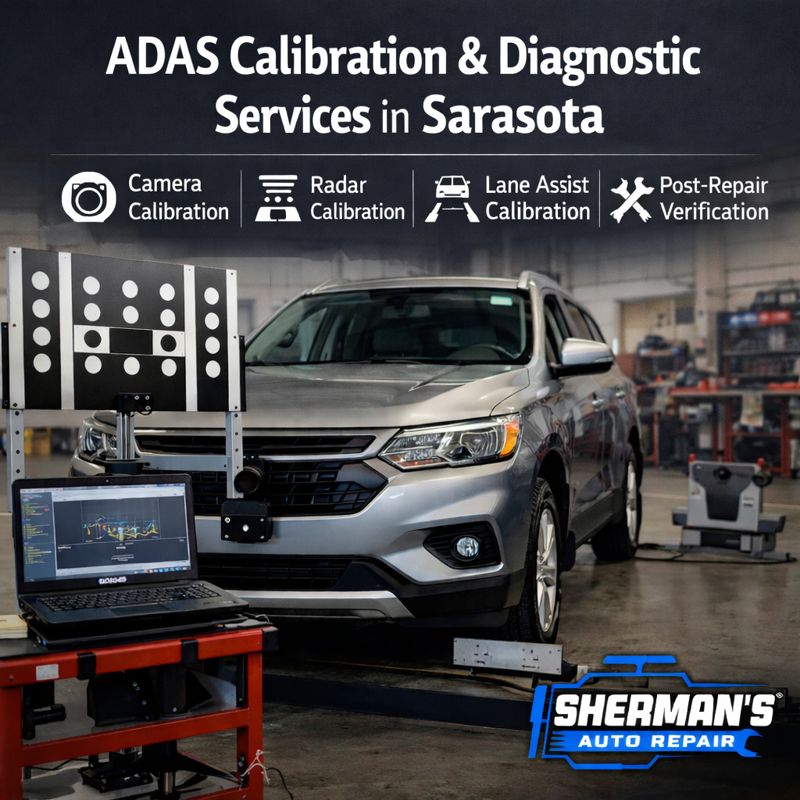
Static calibration is performed in a controlled indoor environment. It is commonly required for camera-based systems such as Honda Sensing, Toyota Safety Sense, Subaru EyeSight, and similar platforms.
Key elements include:
- A level floor or alignment rack
- Controlled lighting without glare or shadows
- Measured distances and heights specified by the manufacturer
- Use of dedicated calibration targets, patterns, or reflective boards
- OEM-compatible diagnostic software to place the system into calibration mode
During static calibration, the vehicle’s cameras or sensors are aligned to precise reference points established by the manufacturer. This process sets the baseline that the system uses to interpret lane position, object distance, and vehicle trajectory.
Static calibration is typically required after windshield replacement, camera removal or replacement, front-end collision repairs, or bumper work.
Dynamic Calibration
Dynamic calibration is performed during a controlled road test under conditions defined by the vehicle manufacturer. It is commonly required for radar-based systems, such as adaptive cruise control and blind-spot monitoring.
During dynamic calibration:
- The vehicle is driven at specific speeds for defined durations
The system collects live data from real driving conditions
Roadway type, traffic flow, and driving stability must meet manufacturer requirements
Dynamic calibration allows the ADAS system to finalize sensor alignment based on real-world inputs. If driving conditions do not meet required parameters, calibration may not complete successfully.
Dynamic calibration is often required after radar sensor replacement, collision repairs, or when specified following static calibration.
Combined Static and Dynamic Calibration
Many newer vehicles require both static and dynamic calibration to fully validate all ADAS features. In these cases:
Static calibration establishes the physical reference baseline
Dynamic calibration confirms accuracy under live driving conditions
Calibration is not considered complete until all required methods have been successfully performed, fault codes are cleared, and system readiness is confirmed through post-calibration verification.
Post-Calibration Verification
Regardless of calibration method, verification is a required final step. This includes:
- Post-calibration diagnostic scanning
Confirmation that no ADAS-related fault codes remain
Review of system status and live data parameters
- Functional checks or verification drives when specified
Verification confirms that the ADAS system is operating within manufacturer specifications and ready for use under normal Sarasota driving conditions.
ADAS Diagnostics and Component Repair
Not all ADAS-related concerns are caused by sensor misalignment or calibration drift. In many cases, system faults originate from component damage, electrical issues, or software-level errors. Accurate diagnosis is required before calibration or repair decisions are made.
ADAS diagnostics may identify issues such as:
- Damaged cameras or radar sensors caused by collisions, road debris, moisture intrusion, or environmental exposure
- Sensor obstruction or degradation, including internal condensation or lens damage
- Wiring or connector faults, including corrosion, pin damage, or intermittent signal loss
- Control module communication errors affecting data transfer between ADAS systems
- Software-related issues, including corrupted data, incomplete updates, or calibration data loss
Diagnosis begins with a complete electronic scan of all ADAS-related control modules, not just the presence of dashboard warning lights. Live data, fault history, and system status are reviewed to determine whether calibration alone is sufficient or if component repair or replacement is required.
When repairs are necessary, manufacturer-approved or equivalent components are used to maintain system compatibility, accuracy, and long-term reliability. Calibration is only performed after the system is confirmed to be physically and electronically sound.
ADAS Service Process
ADAS service follows a structured, manufacturer-aligned process designed to restore system accuracy and confirm operational readiness. Each step is documented to support verification, insurance requirements, and future diagnostics.
1. Vehicle History and Condition Review
Service begins with a review of recent repairs, collision history, windshield replacement, alignment work, or warning indicators that may affect ADAS operation.
2. Comprehensive ADAS Diagnostic Scan
All relevant ADAS modules are scanned to identify:
- Active and stored fault codes
- Communication or initialization errors
- Calibration status and system readiness
This step determines whether diagnostics, calibration, repair, or a combination is required.
3. Findings Review and Procedure Determination
Diagnostic results are evaluated to determine:
- Whether calibration is required
- Whether component repair or replacement is necessary
- Which manufacturer procedures apply to the vehicle
Only required services are performed—calibration is not initiated without meeting prerequisite conditions.
4. Calibration and/or Component Repair
Calibration and repairs are performed using manufacturer-aligned methods, including static calibration, dynamic calibration, or combined procedures as specified. Environmental conditions, setup requirements, and verification steps are followed precisely.
5. Post-Service Verification and Validation
After service completion:
Post-calibration diagnostic scans are performed
System status and live data are reviewed
- Required functional checks or verification drives are completed
This confirms that all ADAS systems are operating within specification.
6. Documentation and Maintenance Guidance
Final documentation records:
- Diagnostic findings
- Calibration and repair procedures performed
- Confirmation of system readiness
Maintenance guidance may include recommendations such as keeping sensors clean and addressing warning indicators promptly, particularly under Sarasota’s coastal driving conditions.
Service Time Expectations
Service time varies based on vehicle design and scope of work.
Standard ADAS calibrations are often completed within several hours
Complex diagnostics or component replacement may require additional time depending on system complexity and parts availability
Time estimates are based on procedural requirements, not shortcuts.
Insurance and Documentation Considerations in Florida
In Florida, comprehensive auto insurance policies commonly cover windshield replacement without a deductible when damage meets coverage criteria. For vehicles equipped with forward-facing cameras, ADAS recalibration is often required by the vehicle manufacturer following windshield replacement to restore system accuracy.
When ADAS recalibration is specified by manufacturer service procedures, many insurers recognize it as a necessary post-repair operation, particularly when documentation confirms the requirement. Proper documentation typically includes:
Pre- and post-service diagnostic scan results
Identification of ADAS systems calibrated or repaired
Confirmation that manufacturer procedures were followed
Accurate records support insurance claim processing, warranty compliance, and future diagnostic reference. Documentation also establishes a service history showing that safety systems were restored according to specification, which may be relevant for resale or post-collision verification.
Environmental Considerations
Sarasota’s coastal environment can influence ADAS performance over time. While ADAS systems are designed to operate in varied conditions, environmental factors may affect sensor clarity and reliability if systems are not properly calibrated or maintained.
Common local considerations include:
High humidity, which may contribute to condensation affecting camera housings
Heavy seasonal rainfall, which can temporarily reduce radar effectiveness
Intense sunlight, which may introduce glare affecting camera-based systems
Salt air and coastal exposure, which can accelerate corrosion on sensor housings or connectors
Insect buildup, road debris, and residue, which may obstruct sensor fields of view
Routine inspection, prompt attention to warning indicators, and keeping camera and sensor areas clean help support consistent ADAS performance under Sarasota driving conditions.
Schedule ADAS Calibration or Diagnostic Service in Sarasota
ADAS technology is designed to assist drivers by reducing risk only when systems operate within manufacturer specifications. Accurate calibration and verified repairs ensure that cameras, radar sensors, and related control modules correctly interpret vehicle position, lane markings, distance, and surrounding traffic.
Professional ADAS service emphasizes:
Measured setup and controlled calibration conditions
Manufacturer-aligned diagnostic and calibration procedures
Post-service verification and documentation
This approach supports reliable system operation on Sarasota roads, including high-traffic corridors, highway merging zones, and urban driving environments. ADAS service is not based on assumptions or resets, but on verification that systems are functioning as designed.
ADAS diagnostics, calibration, and post-repair verification are available at Sherman’s Auto Repair, located at:
757 Gantt Ave, Suite 9
Sarasota, FL 34232
Services are performed by ASE-certified technicians using manufacturer-aligned procedures. Vehicles that have recently undergone windshield replacement, collision repair, alignment work, or are displaying ADAS-related warning indicators should be evaluated to confirm system accuracy and readiness.
Contacts Us
Have a Question?
Contacts Us
Have a Question?
Frequently Asked Questions (FAQs)
Is ADAS calibration required after windshield replacement?
Yes—when specified by the vehicle manufacturer.
Many vehicles use forward-facing cameras mounted to the windshield. When the windshield is removed or replaced, the camera’s optical reference can change, even if no warning light is present. Manufacturer service procedures determine whether recalibration is required, not visual appearance or dashboard alerts.
How long does ADAS calibration usually take?
ADAS calibration time varies by vehicle design and calibration method.
- Standard calibrations are often completed within several hours
- Combined static and dynamic calibrations, or vehicles requiring diagnostics or component repair, may require additional time
Service time is based on manufacturer procedures and verification requirements, not shortcuts.
Will ADAS calibration clear warning lights automatically?
Not always.
Calibration is performed only after diagnostics confirm that all related sensors, components, and control modules are functioning correctly. If warning indicators are caused by sensor damage, wiring faults, or software issues, those problems must be resolved before calibration can be completed successfully. Post-calibration verification confirms whether warning indicators have been cleared and systems are operating within specification.