

CAR AIR CONDITIONING / REFRIGERANT & RECHARGE GUIDE
To properly recharge a car A/C system, identify the correct refrigerant, diagnose cooling problems, check for leaks, recover existing refrigerant when performing a complete recharge, evacuate air and moisture, restore the manufacturer-specified charge weight, and verify cooling performance. Adding refrigerant without understanding the condition of the system can cause more problems than it solves.
When your car’s air conditioning starts blowing warm air instead of keeping you comfortable, you might assume it simply needs more refrigerant. While low refrigerant is a common reason for reduced cooling performance, other mechanical and electrical problems can produce similar symptoms.
If your air conditioner repeatedly loses its ability to cool, professional A/C diagnostics can help determine whether the problem involves refrigerant loss, a failing component, or an electrical malfunction.
Understanding how automotive A/C recharging works can help you avoid unnecessary expenses, protect your compressor, and make better decisions about your vehicle’s maintenance.
What Is a Car A/C Recharge?
A car A/C recharge is a service that restores the refrigerant inside your vehicle’s air conditioning system to the correct quantity so it can effectively remove heat from the passenger compartment.
Your vehicle’s A/C system relies on several components working together:
- A/C compressor: Circulates and compresses refrigerant throughout the system.
- Condenser: Releases heat from the refrigerant to the outside air.
- Expansion valve or orifice tube: Regulates refrigerant flow and pressure.
- Evaporator: Absorbs heat from the air entering your vehicle’s cabin.
- Receiver-drier or accumulator: Helps manage moisture and protect system components.
- Refrigerant: Transfers heat through the air conditioning system.
When refrigerant levels become too low, the system may struggle to absorb and transfer heat efficiently.
However, refrigerant is not a consumable fluid like gasoline or windshield washer fluid. It circulates through a closed system. A noticeable or recurring loss of refrigerant should prompt an inspection for possible leaks.
How Do You Know If Your Car A/C Needs a Recharge?
Before purchasing an A/C recharge kit or scheduling refrigerant service, pay attention to changes in your vehicle’s air conditioning performance.
Common symptoms that may indicate low refrigerant include:
- Air blowing from the vents is warmer than usual.
- The A/C takes longer to cool the passenger compartment.
- Cooling performance changes throughout the drive.
- The air conditioning works intermittently.
- The A/C compressor cycles more frequently than normal on vehicles with cycling compressors.
- Oily residue appears around A/C hoses, fittings, or components.
Although these symptoms may indicate refrigerant loss, they can also be caused by mechanical, electrical, or airflow problems. Understanding the warning signs that your car’s A/C needs repair can help you recognize other air conditioning faults.
| A/C Symptom | Possible Causes |
|---|---|
| Warm air from vents | Low refrigerant, compressor failure, blend door problems |
| Cold air while driving but warm air at idle | Condenser fan malfunction, airflow restrictions, refrigerant problems |
| Weak airflow from vents | Clogged cabin air filter, blower motor problems, evaporator icing |
| Intermittent cooling | Refrigerant loss, electrical faults, sensor problems |
| Unusual compressor noises | Compressor wear, lubrication problems, mechanical damage |
| Cooling disappears shortly after recharging | Refrigerant leak or another unresolved fault |
| Unpleasant odors from vents | Moisture buildup, contaminated filter, microbial growth |
If the air coming from your vents feels cold but the airflow is unusually weak, the problem may be a restricted cabin air filter rather than low refrigerant. An inspection and, when necessary, cabin air filter replacement may help restore proper airflow without unnecessarily recharging the A/C system.
Keep in mind: A recharge will not repair a failed compressor, damaged condenser fan, faulty blower motor, or malfunctioning temperature control system. Symptoms alone cannot establish the correct refrigerant quantity.
What Causes a Car A/C System to Lose Refrigerant?
Automotive air conditioning systems experience constant vibration, temperature changes, and exposure to environmental conditions. Over time, these factors can contribute to refrigerant leaks.
Common refrigerant leak locations include:
- Deteriorated rubber seals and O-rings
- Damaged A/C hoses and refrigerant lines
- Leaking service port valves
- Corroded or damaged condensers
- Compressor shaft seals on applicable systems
- Leaking evaporator cores
- Loose or damaged component connections
Some refrigerant loss may occur gradually through seals and hoses over an extended period. However, repeatedly adding refrigerant without identifying why cooling performance is declining can lead to recurring problems and additional repair expenses.
If your A/C stops cooling again shortly after a recharge, have the system inspected rather than continuing to add refrigerant.
What Type of Refrigerant Does Your Car A/C Need?
One of the most important parts of properly recharging a car A/C system is identifying the correct refrigerant. Different vehicles use different refrigerants, and they are not automatically interchangeable.
| Refrigerant | Common Applications | Important Considerations |
|---|---|---|
| R-12 | Older vehicles, primarily from before the mid-1990s | Requires specialized servicing due to environmental regulations |
| R-134a | Many vehicles manufactured from the mid-1990s through the refrigerant transition period | Still used in existing vehicles designed for it |
| R-1234yf | Many newer cars, trucks, SUVs, hybrids, and EVs | Lower global warming potential; requires compatible equipment |
| R-744 (CO₂) | Select modern vehicle climate systems | Operates at substantially higher pressures and requires specialized servicing |
Many automotive manufacturers began transitioning to R-1234yf during the 2010s. U.S. environmental requirements have since restricted higher-global-warming-potential refrigerants in new light-duty passenger vehicles. This does not mean older R-134a vehicles must automatically switch to R-1234yf.
How to Find Your Car’s Refrigerant Type and Capacity
Most vehicles have an air conditioning information label located under the hood.
Depending on the vehicle, this label may identify:
- The required refrigerant type.
- The specified refrigerant charge weight.
- Compressor lubricant specifications.
- Relevant air conditioning safety information.
If the label is missing or unreadable, consult the manufacturer’s service information for your specific vehicle. Do not determine refrigerant type solely by the vehicle’s age. Different manufacturers adopted newer refrigerants at different times.
What Tools Are Needed to Properly Recharge a Car A/C System?
The equipment required depends on whether you are adding refrigerant to an existing charge or performing a complete automotive A/C service.
| Equipment | Purpose |
|---|---|
| Refrigerant identifier | Confirms refrigerant type and checks for contamination |
| A/C manifold gauges or diagnostic equipment | Evaluates refrigerant pressure and system operation |
| Refrigerant recovery machine | Removes existing refrigerant for proper handling |
| Vacuum pump | Removes air and moisture from the system |
| Calibrated charging equipment | Measures the manufacturer-specified refrigerant quantity |
| Electronic refrigerant leak detector | Helps locate refrigerant leaks |
| Temperature measuring equipment | Evaluates cooling performance |
| Safety glasses and protective gloves | Protects against accidental refrigerant exposure |
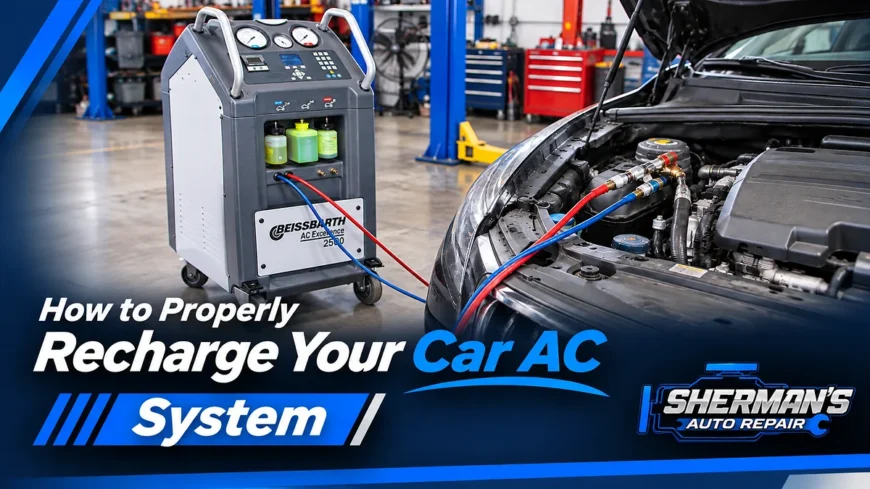
Modern recovery, recycling, and recharge machines can combine several of these functions into a single service station. A basic DIY recharge kit generally cannot perform all the diagnostic and servicing functions of professional equipment.
How to Properly Recharge a Car A/C System
The most accurate way to restore refrigerant levels is to follow the vehicle manufacturer’s service specifications using compatible equipment.
A complete professional A/C recharge generally involves the following eight stages. The exact procedure varies depending on the vehicle, refrigerant, and condition of the system.
01 Evaluate the A/C System Before Adding Refrigerant
The first step is determining whether low refrigerant is actually responsible for the cooling problem. An initial evaluation may include checking vent temperatures, compressor operation, condenser airflow, electrical controls, and refrigerant pressure readings.
This helps distinguish refrigerant loss from other A/C problems. For example, an air conditioner that blows cold air while driving but becomes warm when stopped may have a condenser cooling fan problem rather than a simple refrigerant shortage.
Adding refrigerant before identifying the actual problem may increase system pressure without improving cooling performance.
02 Confirm the Correct Refrigerant and Charge Specifications
Before servicing the system, identify the refrigerant and required charge quantity specified by the vehicle manufacturer.
Using the wrong refrigerant or introducing incompatible substances can contaminate the system and increase repair costs. Refrigerant charge specifications are vehicle-specific. There is no universal quantity that works for every car, truck, or SUV.
03 Recover Existing Refrigerant
If a complete evacuation and recharge is needed, the refrigerant already inside the system must be recovered using appropriate refrigerant recovery equipment. This allows technicians to establish a known starting point instead of guessing how much refrigerant remains in the system.
A vacuum pump is not a substitute for a refrigerant recovery machine.
According to the U.S. Environmental Protection Agency’s automotive A/C servicing requirements, intentional venting of most automotive refrigerants into the atmosphere is prohibited. Technicians who service motor vehicle air conditioning systems for payment must also meet applicable EPA Section 609 certification requirements.
04 Inspect the System for Refrigerant Leaks
Refrigerant loss should be investigated before assuming a recharge will permanently restore cooling.
Depending on the system and suspected fault, leak detection may include:
- Visual inspection of refrigerant lines and connections.
- Electronic refrigerant leak detection.
- Manufacturer-approved fluorescent dye inspection.
- Appropriate pressure-based leak testing.
If a leak is identified, the necessary repair should be completed before restoring the final refrigerant charge.
A system that holds a vacuum is not necessarily free of every possible leak. Certain leaks may only become apparent under operating pressure or specific temperature conditions.
05 Evacuate Air and Moisture From the System
Following refrigerant recovery and any necessary repairs, the A/C system is evacuated using suitable equipment. Evacuation removes non-condensable gases and moisture that can interfere with the refrigeration cycle.
Excess moisture can contribute to internal corrosion, lubricant degradation, and restrictions within the system. The required evacuation process depends on manufacturer instructions, equipment specifications, and whether the system has been exposed to outside air.
06 Restore the Correct Compressor Oil Quantity When Required
Refrigerant is not the only substance circulating through your car’s A/C system. Compressor lubricant plays an important role in protecting moving components and maintaining reliable operation.
Additional oil may be required after certain component replacements or refrigerant recovery procedures. However, adding oil unnecessarily can also affect system performance.
The correct lubricant type and quantity depend on the vehicle manufacturer, compressor design, refrigerant, and repair performed. This is particularly important for hybrid and electric vehicles that use electrically driven compressors.
07 Recharge the System With the Specified Refrigerant Weight
Once the system is ready for charging, the specified refrigerant quantity is restored using calibrated equipment.
Refrigerant pressure readings are useful for diagnosing system operation, but they are affected by ambient temperature, compressor operation, airflow, and system design. A pressure reading alone cannot reliably establish the total amount of refrigerant inside the system.
Charging according to the manufacturer’s specified weight helps prevent both undercharging and overcharging.
08 Verify Air Conditioning Performance
After recharging, the system should be evaluated to confirm that it is functioning correctly.
A final performance inspection may include:
- Measuring air temperature at the vents.
- Evaluating high-side and low-side operating pressures.
- Confirming compressor operation.
- Checking condenser cooling fan performance.
- Inspecting for signs of refrigerant leakage.
- Verifying consistent cooling performance.
There is no single vent temperature that applies to every vehicle under every weather condition. Cooling performance should be assessed according to the manufacturer’s specifications and the conditions under which the vehicle is being tested.
A successful recharge is not simply one that makes the air feel colder. The system should operate within its intended specifications without unresolved faults.
Is a Car A/C Recharge the Same as Adding Refrigerant?
Although these terms are often used interchangeably, there are important differences between topping off refrigerant and completing a full A/C recharge service.
| Refrigerant Top-Off | Complete A/C Evacuation and Recharge |
|---|---|
| Adds refrigerant to the existing charge | Recovers existing refrigerant before restoring the specified charge |
| Existing refrigerant quantity may be unknown | Establishes a known refrigerant quantity |
| Usually involves limited testing | Allows more comprehensive system evaluation |
| Does not remove existing air or moisture | Includes evacuation when appropriate |
| Does not repair refrigerant leaks | Can be performed after necessary leak repairs |
| May provide temporary cooling improvement | Restores the correct refrigerant level when properly completed |
The EPA also explains these differences in its guide to options for recharging your vehicle’s air conditioner.
A refrigerant top-off may improve cooling temporarily, but it should not be confused with repairing the underlying cause of refrigerant loss.
Can You Recharge Your Car A/C Yourself?
DIY car A/C recharge kits are available for certain automotive air conditioning systems. These products generally include a refrigerant container, a service hose, and a pressure gauge.
However, purchasing a recharge kit does not establish that your vehicle actually needs refrigerant. A DIY kit typically cannot determine the precise quantity already inside the system, remove contaminated refrigerant, perform complete evacuation, or diagnose all electrical and mechanical A/C problems.
Before considering a DIY recharge, confirm the vehicle’s refrigerant specifications and whether the manufacturer permits the intended servicing method.
Safety: Never mix refrigerants, use an unapproved refrigerant substitute, bypass safety controls, or deliberately release refrigerant to reduce system pressure. Refrigerant exposure can cause serious cold burns and eye injuries. Some modern refrigerants also present flammability concerns.
Professional servicing is particularly advisable when:
- The A/C system has completely stopped cooling.
- Refrigerant leaks are suspected.
- A compressor or another major component has been replaced.
- The system has been opened to the atmosphere.
- The refrigerant type or existing charge is unknown.
- The vehicle uses a specialized hybrid or electric climate system.
- A previous recharge failed to restore lasting cooling.
Common Car A/C Recharge Mistakes to Avoid
Improper charging can reduce cooling performance and place unnecessary stress on expensive air conditioning components.
01 Adding Refrigerant Without Diagnosing the Problem
Warm air does not automatically mean low refrigerant. Adding more refrigerant to a properly charged system can create additional faults.
02 Overcharging the A/C System
More refrigerant does not mean colder air. An overcharged system can experience excessive operating pressure, reduced cooling efficiency, increased compressor stress, and protective system shutdowns.
03 Using the Wrong Refrigerant
Refrigerants have different operating characteristics and servicing requirements. Mixing incompatible refrigerants can contaminate the A/C system and servicing equipment.
04 Using Unnecessary Leak-Sealing Additives
Refrigerant products containing unapproved sealants or other additives may introduce complications during future diagnostics and servicing. A proper leak repair addresses the damaged component or connection instead of relying on an additive to conceal the problem.
05 Ignoring Compressor Oil Specifications
Incorrect lubricant types or quantities can affect compressor lubrication, cooling efficiency, and electrical insulation in certain electric compressors.
06 Skipping Leak Detection
If refrigerant is escaping from the system, recharging alone will not prevent it from escaping again.
07 Relying Entirely on a Recharge Kit Pressure Gauge
System pressure is influenced by several operating conditions. A gauge reading should not be treated as a universal measurement of refrigerant quantity.
What Happens If You Overcharge Your Car A/C?
Overcharging occurs when the air conditioning system contains more refrigerant than the vehicle manufacturer specifies.
Possible symptoms include:
- Reduced cooling performance.
- Abnormally high system pressure.
- Intermittent compressor operation.
- Compressor shutdown.
- Unusual compressor noises.
- Increased load on the compressor.
In severe cases, excessive pressure and improper system operation may contribute to component damage.
If you suspect that your A/C system has been overcharged, have the refrigerant quantity corrected using appropriate recovery and charging equipment. Do not attempt to correct the charge by releasing refrigerant into the atmosphere.
Why Is My Car A/C Still Blowing Warm Air After a Recharge?
If your air conditioning continues blowing warm air after adding refrigerant, the system may have a problem that charging cannot correct.
Possible causes include:
- An unresolved refrigerant leak.
- Too much or too little refrigerant.
- A failing A/C compressor.
- A defective condenser cooling fan.
- A restricted condenser or expansion device.
- Faulty pressure or temperature sensors.
- Electrical wiring or control module problems.
- A malfunctioning blend door.
- Air or contamination inside the refrigerant circuit.
Modern automotive A/C systems depend on electrical signals to control compressor operation, cooling fans, sensors, and temperature regulation.
If the refrigerant charge is correct but the compressor or cooling fan is not operating as expected, automotive electrical diagnostics may be necessary to determine whether a wiring fault, damaged relay, sensor, or control module is responsible.
Repeatedly adding refrigerant can make diagnosis more difficult and potentially cause further damage.
Can You Recharge the A/C in a Hybrid or Electric Vehicle?
Hybrid and electric vehicle air conditioning systems may differ significantly from conventional engine-driven A/C systems.
Many use high-voltage electric compressors that require specifically approved lubricants with suitable electrical insulation properties. In some vehicles, the refrigerant circuit may also contribute to high-voltage battery thermal management.
Using an incompatible lubricant or contaminated servicing equipment can compromise electrical insulation and damage the compressor.
For hybrid vehicle owners, working with technicians experienced in hybrid vehicle diagnostics and repair is especially important when climate control problems may involve electrical or high-voltage components.
Always follow the vehicle manufacturer’s specifications and have specialized climate systems serviced by appropriately trained technicians.
How Often Should You Recharge Your Car A/C?
There is no universal maintenance interval for recharging an automotive air conditioning system.
Unlike an engine oil change, refrigerant replacement is generally based on system condition, manufacturer requirements, or repairs that involve opening the refrigerant circuit. If your air conditioning continues operating correctly and no refrigerant-related service is required, adding refrigerant unnecessarily offers no benefit.
Consider an A/C performance inspection when:
- Cooling becomes noticeably weaker.
- The air conditioner struggles during hot weather.
- Refrigerant loss is suspected.
- Cooling becomes inconsistent.
- Unusual compressor noises develop.
Regular vehicle maintenance can also help identify related problems before they interfere with air conditioning performance. A preventive maintenance inspection can identify concerns such as restricted cabin air filters, deteriorating drive belts, and other maintenance issues that may affect vehicle reliability.
An inspection does not automatically mean that your vehicle needs an A/C recharge.
Why Proper A/C Recharging Matters for Florida Drivers
Driving in Sarasota, Florida, means dealing with high temperatures, humidity, and vehicles that can become extremely warm while parked in direct sunlight.
Your air conditioning system must remove heat from the passenger compartment while also reducing humidity. When refrigerant levels are incorrect, condenser airflow is restricted, or A/C components are failing, the effects may become particularly noticeable during hot afternoons and stop-and-go traffic.
Signs that your vehicle’s A/C system may be struggling include:
- The cabin takes increasingly longer to cool down.
- Cooling performance decreases when stopped in traffic.
- The air conditioner cannot maintain a comfortable temperature.
- Cooling becomes inconsistent during extended drives.
It is also important to understand that your vehicle’s air conditioning and engine cooling systems serve different purposes, even though they may share cooling fans or related airflow components.
If your A/C becomes warm while idling and your engine temperature also begins to rise, an engine cooling system inspection may help identify a shared cooling fan or airflow problem. If the engine is overheating, pull over safely and shut off the vehicle.
These symptoms should be investigated rather than automatically attributed to Florida’s weather. Proper A/C diagnostics and servicing can help identify the reason your air conditioning is struggling before unnecessary refrigerant is added or parts are replaced.
Frequently Asked Questions About Car A/C Recharging
How much refrigerant does my car A/C need?
The required refrigerant quantity depends on your vehicle’s specific air conditioning system. Check the under-hood A/C information label or the manufacturer’s service specifications. Never assume that every vehicle requires the same amount.
Can you recharge car A/C without a vacuum pump?
A refrigerant top-off may not involve vacuum evacuation when the system remains closed and contains refrigerant. However, a complete recharge following refrigerant recovery or an opened system generally requires appropriate evacuation equipment to remove air and moisture.
Can I add refrigerant without removing the old refrigerant?
Adding refrigerant to an existing charge is known as topping off. The limitation is that the existing refrigerant quantity may be unknown. A complete recovery and recharge allows the system to be restored to its specified charge weight.
How long does it take to recharge a car A/C system?
A basic recharge service may take around an hour or longer, depending on the equipment and required procedures. Leak detection, component repairs, and additional diagnostics can increase the total service time.
How long should a car A/C recharge last?
There is no guaranteed recharge lifespan. A correctly serviced system without significant refrigerant leaks may continue operating for years. If cooling performance declines shortly after recharging, further diagnosis is necessary.
Does Freon expire in a car?
Automotive refrigerant does not normally expire inside a properly operating system. Reduced cooling is more commonly associated with refrigerant loss, contamination, or component malfunction. Freon is a trade name often used informally to refer to automotive refrigerant.
Can a car A/C system lose refrigerant without a visible leak?
Yes. Small refrigerant leaks may not leave obvious visible evidence. Gradual loss can occur through seals, connections, hoses, or components. Specialized leak detection equipment may be needed to identify the source.
Will recharging my A/C fix a bad compressor?
No. Adding refrigerant cannot repair a mechanically damaged or electrically failed compressor. Compressor operation and the rest of the A/C system must be evaluated to determine the appropriate repair.
Can low refrigerant damage the A/C compressor?
Yes. Insufficient refrigerant can interfere with lubricant circulation and normal compressor operation. Depending on the system design, prolonged operation under incorrect conditions may contribute to premature compressor wear.
Can I mix R-134a and R-1234yf refrigerants?
No. These refrigerants have different servicing requirements and must not be mixed. Use only the refrigerant specified for your vehicle unless an approved conversion procedure specifically applies.
Why does my car A/C work while driving but not at idle?
A common possibility is inadequate condenser airflow caused by a malfunctioning cooling fan. Refrigerant charge problems, compressor performance, or other system faults can also produce this symptom.
Is professional car A/C recharge better than using a DIY kit?
Professional equipment allows technicians to recover existing refrigerant, evaluate system operation, check for leaks, remove air and moisture when necessary, and restore the specified refrigerant quantity. A DIY kit generally provides more limited servicing capabilities.
Professional Car A/C Recharge and Repair in Sarasota, FL
Your car’s air conditioning should provide dependable cooling without requiring repeated refrigerant top-offs.
At Sherman’s Auto Repair in Sarasota, FL, we focus on identifying the actual cause of an air conditioning problem before recommending repairs or adding refrigerant.
Our automotive A/C diagnostic services can help identify problems involving:
- Reduced air conditioning performance.
- Incorrect refrigerant charge and abnormal pressures.
- Refrigerant leaks.
- A/C compressor and other component faults.
- Electrical and climate-control malfunctions.
- Inconsistent cooling performance.
Whether your A/C is blowing warm air, struggling in Sarasota traffic, or losing cooling performance shortly after a recharge, our ASE-certified technicians can help determine what your vehicle needs and explain the recommended repairs.
Our approach to car A/C repair and diagnostics in Sarasota, FL focuses on identifying the underlying fault and restoring reliable cooling rather than masking the symptoms with repeated refrigerant refills.
Request Car A/C Service in Sarasota, FL
Sherman’s Auto Repair
757 Gantt Ave, Suite 9, Sarasota, FL 34232
Phone: (941) 444-7057
Explore Our Car A/C Repair & Diagnostic Services in Sarasota, FL
Instead of guessing whether your car needs more refrigerant, get the answers you need to restore dependable cooling.

