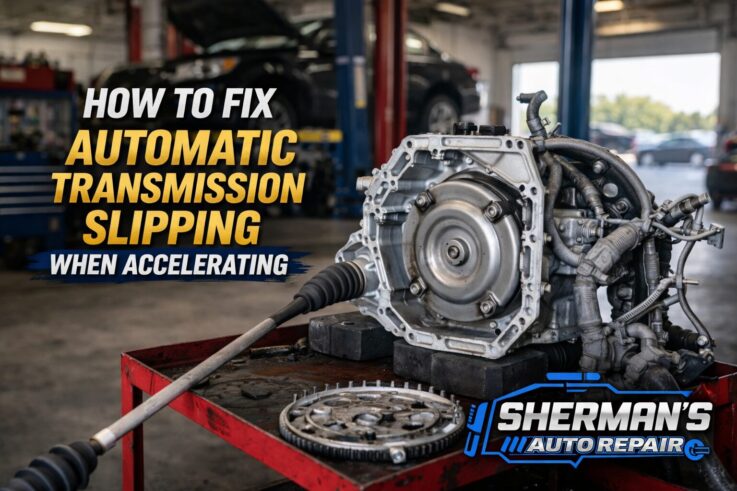

If your vehicle hesitates, revs higher than normal, or feels like it’s struggling to stay in gear when you press the accelerator, your automatic transmission may be slipping.
Transmission slipping is not a minor issue. It is a sign that power from the engine is not being transferred properly to the wheels. Left unaddressed, it can lead to complete transmission failure.
The key is to identify the cause early and apply the correct fix — not guess.
Understanding Transmission Slipping
In a properly functioning automatic transmission, gear changes happen smoothly and power is delivered consistently as you accelerate.
When slipping occurs, you may notice:
- Engine revving increases without matching speed
- Delayed or harsh shifting
- Difficulty climbing hills
- Burning smell
- Vehicle feels like it “falls out of gear”
This happens when internal components fail to maintain the necessary pressure, friction, or engagement needed to hold a gear.
What Causes Transmission Slipping?
Before fixing the issue, you need to understand what is causing it. Slipping is a symptom — not the root problem.
The most common causes include:
Low or Degraded Transmission Fluid
Transmission fluid provides hydraulic pressure, lubrication, and cooling. If the fluid is low, dirty, or burned, the transmission cannot maintain proper pressure.
Worn Clutch Packs or Bands
Inside the transmission are clutch packs and bands that hold gears in place. Over time, friction material wears down, causing slippage under load.
Faulty Solenoids
Transmission solenoids control fluid flow. If they malfunction, gear engagement becomes inconsistent.
Torque Converter Issues
The torque converter transfers engine power into the transmission. If it fails, acceleration becomes weak or inconsistent.
Internal Wear or Damage
Gears, seals, and internal components can wear or fail, especially in high-mileage vehicles.
How to Fix Automatic Transmission Slipping
Now we move to the actual fix — step-by-step, in the correct order.
Step 1: Check Transmission Fluid Level and Condition
What to use:
- Clean cloth or paper towel
- Vehicle owner’s manual
Process:
- Park on level ground
- Start the engine and let it warm up
- Locate the transmission dipstick (if equipped)
- Pull it out, wipe clean, reinsert, and check level
- Observe fluid condition
What to look for:
- Healthy fluid: red or pink, slightly transparent
- Problem fluid: dark, brown, or burnt smell
Fix:
- If low → add manufacturer-recommended transmission fluid
- If dirty or burnt → perform transmission fluid change or flush
This is the simplest and most common fix.
Step 2: Inspect for Transmission Fluid Leaks
What to use:
- Flashlight
- Clean surface or cardboard under vehicle
Process:
- Check under the vehicle for red or dark fluid spots
- Inspect transmission pan, seals, and cooler lines
Fix:
- Tighten loose components
- Replace leaking seals or gaskets
Fluid loss leads directly to pressure loss — which causes slipping.
Step 3: Scan for Diagnostic Trouble Codes (DTCs)
What to use:
- OBD-II scanner
Process:
- Plug scanner into the vehicle’s diagnostic port
- Check for transmission-related codes
Common codes may indicate:
- Solenoid failure
- Pressure issues
- Gear ratio errors
Fix:
- Replace faulty solenoids
- Address electrical or sensor issues
Modern transmissions rely heavily on electronic control.
Step 4: Evaluate Transmission Response During Driving
What to observe:
- Delayed shifting
- Sudden RPM spikes
- Slipping under load
This helps determine if the issue is fluid-related or internal.
If slipping occurs only under acceleration, it often points to worn clutch packs or pressure issues.
Step 5: Perform a Transmission Fluid Service (If Needed)
If fluid is degraded but no major damage is present:
Options:
- Drain and refill
- Full transmission flush (if recommended for your vehicle)
This restores fluid quality and hydraulic performance.
Step 6: Address Internal Transmission Wear
If slipping continues after fluid and electrical checks:
Likely causes:
- Worn clutch packs
- Damaged bands
- Internal seal failure
Fix options:
- Transmission repair
- Partial rebuild
- Full transmission rebuild or replacement
At this stage, professional service is required.
Can You Continue Driving With a Slipping Transmission?
No — not for long.
Driving with a slipping transmission:
- Increases internal heat
- Accelerates wear
- Can lead to complete failure
The longer it slips, the more expensive the repair becomes.
The Real Fix
Transmission slipping is not solved by guesswork.
The correct approach is:
- Check and correct fluid level and condition
- Identify leaks
- Scan for electronic faults
- Test performance
- Repair internal components if necessary
Fix the cause — not just the symptom.
When to Seek Professional Help
If fluid is clean and at the correct level, but slipping continues, the issue is likely internal.
Automatic transmissions are complex systems that require specialized tools and experience to diagnose and repair properly.
Get Professional Transmission Diagnosis in Sarasota
If your vehicle is slipping when accelerating, don’t wait for the problem to get worse.
Sherman’s Auto Repair in Sarasota provides professional transmission diagnostics, fluid service, and repair solutions to restore proper performance and prevent further damage.
Have your transmission inspected early — before a minor issue turns into a major repair.

